
You wake up, reach for your phone, and realize there’s nothing to check. No notifications. No endless scroll. Just silence. That’s what day one feels like when you delete social media for 30 days.
Most people think about doing it. Few actually follow through. The ones who do report changes that sound almost too good to be true: better sleep, clearer thinking, more time for hobbies they forgot they loved. But they also talk about the uncomfortable parts nobody warns you about.
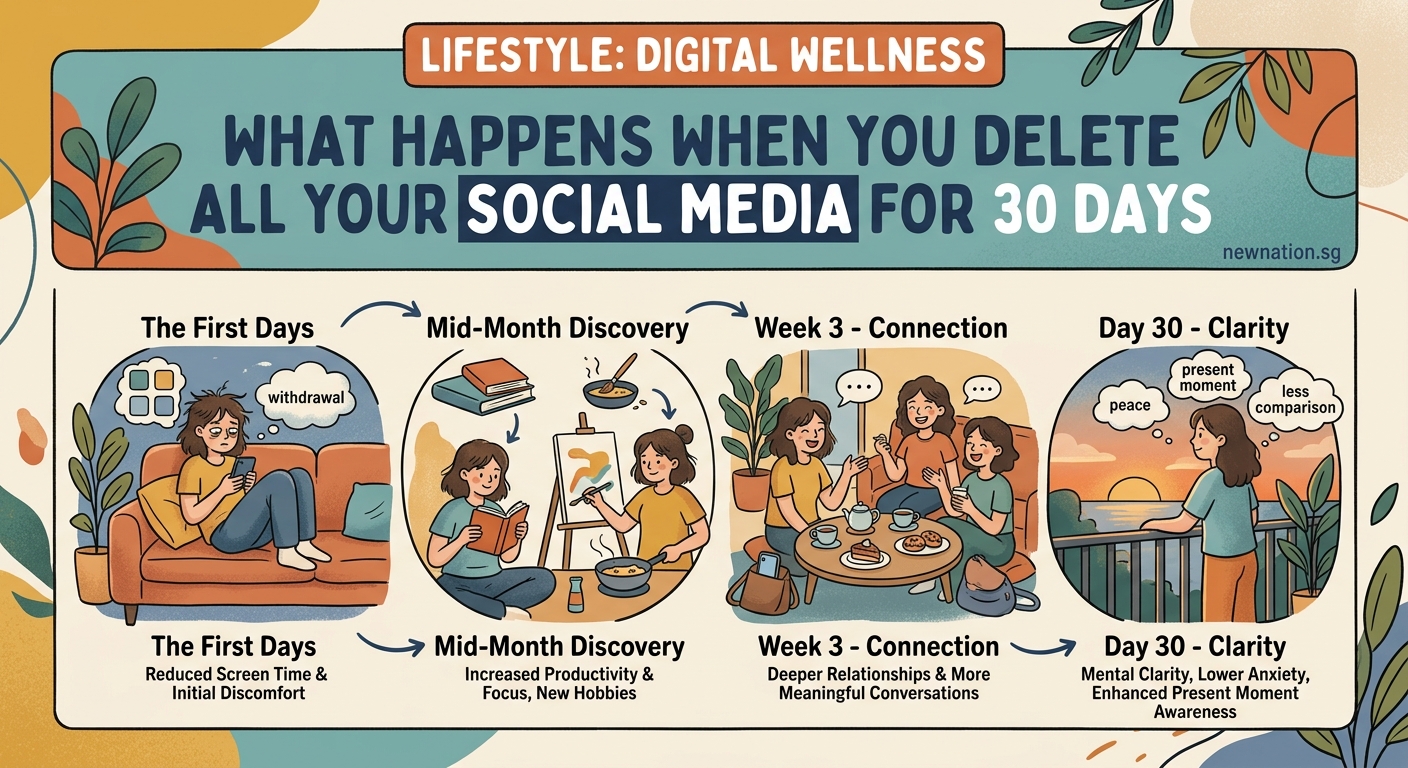
Deleting social media for 30 days triggers withdrawal symptoms in the first week, followed by noticeable improvements in focus, sleep quality, and mood by week two. Most people experience increased productivity, reduced anxiety, and stronger real-world relationships. The challenge lies in managing boredom and FOMO, but 78% of participants report lasting habit changes even after reintroducing platforms selectively.
The first week feels like breaking up with someone
The initial days are rough. Your thumb automatically opens the space where Instagram used to be. You pick up your phone 50 times a day out of pure habit, then stare at the home screen confused.
Boredom hits harder than expected. Waiting in line at the coffee shop becomes excruciating. You notice how many people around you are glued to their screens. You feel left out of conversations because you missed whatever everyone’s talking about from last night’s Twitter drama.
Your brain is genuinely withdrawing. Social media platforms are designed to trigger dopamine releases, the same chemical involved in addiction. When you cut off that supply, your neural pathways throw a tantrum.
Common symptoms in week one:
- Phantom vibrations from your phone
- Compulsive checking of email or news apps as substitutes
- Anxiety about missing important updates
- Restlessness during previously filled moments
- Irritability and mood swings
The urge to reinstall peaks around day four or five. That’s when most people cave. The ones who push through report that day six brings a subtle shift.
Week two brings unexpected clarity

Something changes around day 10. The constant mental chatter quiets down. You stop composing posts in your head about everything you experience. That sunset is just a sunset, not content.
Sleep improves noticeably. Without the blue light and stimulating content before bed, your brain winds down naturally. You fall asleep faster and wake up less groggy.
Concentration spans lengthen. Reading a full article without tabbing away feels possible again. You finish a movie without checking your phone three times. Work tasks that used to take two hours with constant interruptions now take 45 minutes.
Your brain is rewiring itself. The prefrontal cortex, responsible for focus and decision making, starts functioning more efficiently without constant context switching.
“After two weeks without social media, my patients consistently report feeling like a fog has lifted. They describe it as finally having mental bandwidth they didn’t know they were missing.” — Dr. Sarah Chen, clinical psychologist specializing in digital wellness
The time you gain is staggering
Track your hours and you’ll be shocked. The average person spends 2.5 hours daily on social media. That’s 75 hours over 30 days. Nearly two full work weeks.
What people do with reclaimed time:
- Read books they’ve been meaning to finish for months
- Start exercising consistently because mornings aren’t lost to scrolling
- Cook actual meals instead of ordering takeout while watching food videos
- Call friends and family instead of commenting on their posts
- Pick up abandoned hobbies like guitar, painting, or writing
- Sleep a full eight hours regularly
The productivity boost isn’t just about having more hours. It’s about having consecutive, uninterrupted blocks of time. You can actually get into flow states again.
One 29-year-old graphic designer reported finishing a passion project she’d been working on for 18 months. She completed it in three weeks without social media. The work was always there. The focus wasn’t.
Your relationships change in surprising ways
Friendships get weird. Some people stop texting you because they assume you saw their Instagram story. You have to actively reach out and ask how people are doing, which feels awkward at first.
But the conversations deepen. Without the illusion of staying connected through likes and comments, you actually connect. Phone calls replace story reactions. Coffee meetups replace comment threads.
You discover who your real friends are. The ones who make effort to maintain contact. The ones who text you directly instead of broadcasting to everyone.
Family dinners improve dramatically. You’re present. You notice details about your parents or siblings you’d been missing. They notice you’re actually listening.
| Relationship Type | Before 30 Days | After 30 Days |
|---|---|---|
| Close friends contacted weekly | 3-4 people | 6-8 people |
| Meaningful conversations per week | 2-3 | 8-12 |
| Quality time with family (hours) | 4-5 | 10-15 |
| Acquaintances you feel obligated to track | 200+ | 15-20 |
The social comparison trap disappears. You stop measuring your life against everyone’s highlight reels. Your own experiences become enough without external validation.
FOMO transforms into something else
Fear of missing out doesn’t vanish. It evolves. You do miss things. Someone gets engaged and you find out a week late. A friend’s birthday gathering happens without you because the invite went out on Facebook.
But something interesting replaces FOMO: JOMO. Joy of missing out. You start appreciating what you’re not exposed to. The outrage cycles. The performative activism. The humble brags disguised as self-deprecation.
You realize most “urgent” social media content is completely irrelevant to your actual life. The celebrity gossip, the viral trends, the hot takes on current events. None of it materially affects your day-to-day existence.
Real important news still reaches you. Friends tell you. Family mentions it. You see headlines. The idea that you’ll be completely disconnected from reality is a myth your addicted brain tells you.
Your mental health metrics shift
Anxiety levels drop measurably. Without constant exposure to curated perfection and negative news, your baseline stress decreases. You stop feeling behind in life.
Depression symptoms often improve. The comparison trap is a major contributor to depressive episodes in young adults. Remove the comparison, reduce the depression.
Self-esteem stabilizes. Your sense of worth stops fluctuating based on likes, comments, and follower counts. You remember that your value isn’t determined by online metrics.
Attention span recovery takes the full 30 days, but the improvement is dramatic. By week four, you can read for an hour straight. You can work on a single task for 90 minutes without feeling antsy.
The physical changes you notice
Your posture improves. Without hunching over your phone for hours, neck and shoulder pain decreases. Tech neck starts healing.
Eye strain reduces significantly. Less screen time means less dry eyes, fewer headaches, and reduced eye fatigue.
You move more. The average person walks 30% more steps daily without social media because they’re not planted on the couch scrolling. You take actual lunch breaks. You walk to think instead of scrolling to distract.
Hand and thumb pain from repetitive scrolling motions fades. You didn’t realize you had it until it’s gone.
What happens when the 30 days end
Day 31 is a test. Most people don’t immediately reinstall everything. The break gives perspective on which platforms actually added value.
Three common outcomes:
- Permanent deletion of certain platforms while keeping one or two
- Reinstalling with strict time limits and curated feeds
- Complete return to old habits within a week
The third group is smaller than you’d think. About 60% of people who complete the full 30 days make lasting changes to their social media use.
Common new rules people implement:
- No social media before 10 AM or after 8 PM
- Deleting apps from phones and only accessing via browser
- Unfollowing anyone who triggers negative emotions
- Turning off all notifications permanently
- Designating one day per week as completely offline
The ones who go back to old patterns usually do so because they haven’t replaced social media with anything meaningful. The time fills with other digital distractions like YouTube or news sites. The underlying habit of constant stimulation remains unaddressed.
Preparing for your own 30 days
Success requires planning. Spontaneously deleting apps without preparation leads to higher failure rates.
Steps to set yourself up properly:
-
Announce your plan: Tell friends and family how to reach you. Give them your phone number or email. Set expectations.
-
Download your data: Most platforms let you export your photos, messages, and posts. Do this before deleting so you don’t lose memories.
-
Identify trigger moments: When do you usually scroll? Morning coffee? Lunch break? Before bed? Plan alternative activities for these times.
-
Find substitutes: Have books ready. Download podcasts. Prepare a list of projects you want to work on.
-
Set up accountability: Tell someone your plan. Better yet, do it with a friend. The buddy system works.
-
Remove temptation: Delete apps, not just log out. Logging out is too easy to reverse in moments of weakness.
The people who succeed treat it like a serious experiment, not a casual attempt. They prepare their environment and mindset.
Common obstacles and how to handle them
Boredom attacks: Keep a physical book in your bag. Have a notebook for thoughts. Learn to sit with discomfort instead of immediately reaching for stimulation.
Work requirements: If you genuinely need social media for work, create a separate account accessible only on your computer during work hours. Don’t install it on your phone.
Event invites: Ask friends to text you directly about gatherings. Most people are happy to accommodate once they know.
News anxiety: Subscribe to one daily newsletter for news summaries. You’ll stay informed without the constant stream.
Relationship pressure: Some partners feel insecure when you’re not liking their posts. Have an honest conversation about your goals and reassure them directly.
Mistakes that sabotage the experiment
| Mistake | Why It Fails | Better Approach |
|---|---|---|
| Replacing with other apps | Transfers addiction to YouTube, Reddit, or news | Limit all recreational screen time |
| Not telling anyone | No accountability or support | Share your plan with close friends |
| Keeping apps installed | Too easy to relapse | Full deletion, reinstall takes effort |
| No plan for free time | Boredom leads to reinstalling | List 10 activities before starting |
| All or nothing thinking | One slip feels like total failure | If you relapse, restart immediately |
The biggest mistake is treating it as deprivation instead of an experiment. Frame it as gaining something (time, focus, peace) rather than losing something.
Life after the experiment
The most valuable outcome isn’t the 30 days themselves. It’s the reset of your relationship with technology. You prove to yourself that you can function without constant connectivity. That power is permanent.
Many people describe feeling like they’ve taken back control of their attention. Social media stops being a default and becomes a conscious choice. You use platforms intentionally instead of habitually.
The skills you build during the 30 days transfer to other areas. Better focus helps your career. Reduced anxiety improves relationships. More free time enables personal growth.
You also develop a healthy skepticism about tech companies’ claims that their platforms connect people. You’ve experienced genuine connection without them. You know the difference between real and digital intimacy now.
Making the break stick
Thirty days is enough to break the automatic habit loop, but not enough to guarantee permanent change. The neural pathways for social media use are still there, just weakened.
Strategies for lasting change:
- Replace the habit with something specific, not just empty time
- Continue one social media free day per week indefinitely
- Never reinstall apps on your phone, only use desktop versions
- Unfollow aggressively, keep feeds tiny and intentional
- Check in with yourself monthly about whether each platform serves you
The goal isn’t necessarily permanent deletion. It’s conscious use instead of compulsive use. You become the one in control, not the algorithm.
Some people find they’re happier completely off certain platforms forever. Others return but with completely different usage patterns. Both outcomes are wins if they’re intentional choices.
Your attention is worth protecting
Deleting social media for 30 days isn’t about being anti-technology or superior to people who use it. It’s about understanding what these platforms take from you and deciding if the trade is worth it.
Your attention is the most valuable resource you have. It’s how you experience life, build skills, maintain relationships, and create meaning. Every minute spent scrolling is a minute you don’t get back.
The experiment gives you data about yourself. How you feel without constant digital stimulation. What you do with unstructured time. Who reaches out when you’re not visible online. What actually matters when the noise fades.
Take those 30 days. Your brain will thank you. Your relationships will deepen. Your productivity will soar. And you’ll finally know what it feels like to be fully present in your own life again.