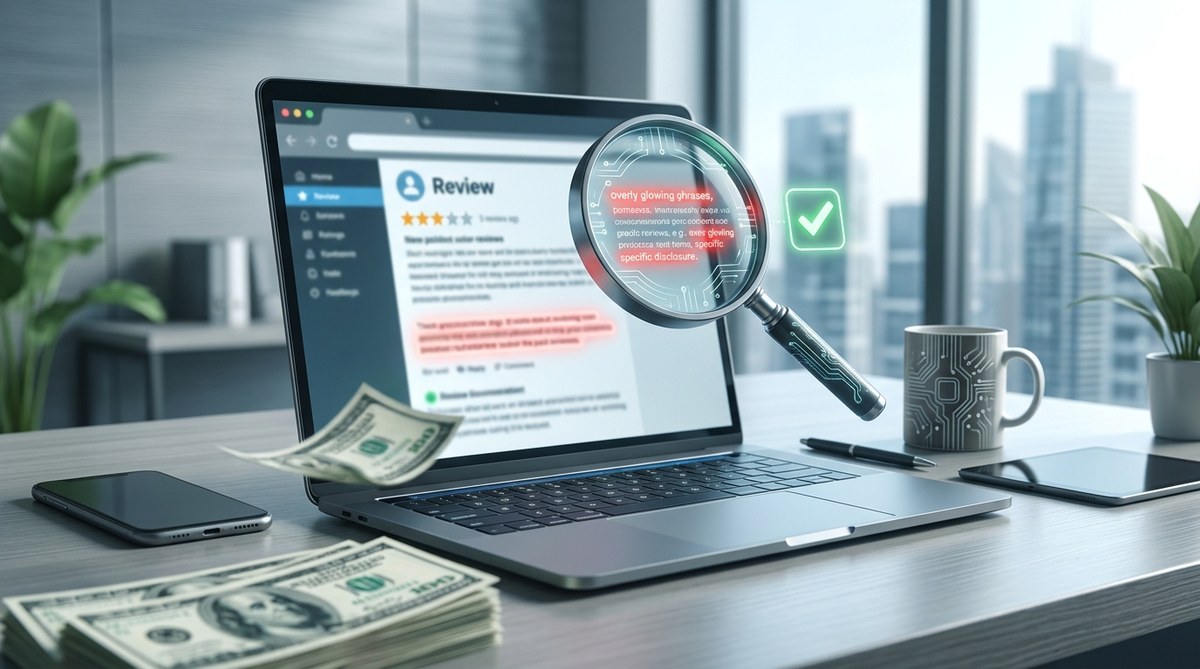
You are watching a video review for a pair of wireless earbuds. The creator raves about the bass, the battery life, and the fit. They say it is the best pair they have tested all year. Then you scroll to the comments and see a dozen people asking the same question: “Did they pay you to say that?”
It is a fair question. The tech review space is full of paid promotions, affiliate link chases, and outright fake content. Some reviews are honest. Many are not. The difference is getting harder to spot.
If you want to know how to tell if a tech review is bought, you need to look past the hype and check for specific signs. This guide will show you exactly what to watch for.
A bought tech review often hides its bias behind vague praise, missing negatives, and excessive affiliate links. To spot one, check for disclosure labels, look at the reviewer’s history with similar products, and cross-reference opinions across multiple sources. If a review sounds too good to be true, it probably is.
The Red Flags That Scream “Paid Promotion”
Not every sponsored review is dishonest. Many creators are upfront about partnerships. But paid reviews share common traits that set them apart from honest assessments.
Vague language is a big clue. A paid review will say things like “game changing” or “incredible value” without explaining why. Honest reviews get specific. They talk about latency in milliseconds, color accuracy under different lighting, or how the software crashes on certain operating systems.
Missing negatives are another warning. No product is perfect. A review that mentions zero downsides is likely skipping them on purpose. Even the best smartphone has a weak point, whether it is battery drain, a fragile charging port, or bloatware. If the reviewer does not mention a single flaw, ask yourself why.
Overly polished production can also be a sign. Some paid reviews look like mini commercials. They have professional lighting, scripted dialogue, and a structure that feels more like an ad than a conversation. That does not mean every polished video is fake. But it is worth checking if the creator normally produces that kind of content or only does it for certain brands.
A Simple Process for Vetting Any Tech Review
You can run any tech review through a basic checklist to gauge its trustworthiness. Here is a process that works.
-
Check the disclosure. Look for phrases like “sponsored,” “paid partnership,” or “ad.” In the United States, the FTC requires influencers to disclose paid relationships. If you see no disclosure but the review feels promotional, that is a red flag.
-
Look up the reviewer’s history. Do they always praise products from this brand? Have they criticized similar products before? A reviewer who only posts positive content about one company is likely getting paid under the table.
-
Search for the product on Reddit or forums. Real users are less filtered. If the consensus on Reddit contradicts the glowing review, trust the crowd. For example, if a reviewer calls a laptop “the best value in 2026” but Reddit users are complaining about coil whine and poor thermals, something is off.
-
Check the affiliate links. Many reviewers earn a commission when you buy through their links. That is fine. But if the review is full of links and light on actual testing, the creator might be prioritizing commissions over honesty.
-
Compare multiple reviews. Watch or read at least three reviews from different sources. If they all say the same thing in the same way, they might be working from the same press release rather than hands-on experience.
What To Look For When Scanning a Review
Sometimes you do not have time to deep dive. You just want to know if a review is worth your attention. Here is what to scan for.
- No unboxing or real-world footage. If the review only uses stock images or press renders, the reviewer may not have the product at all.
- Overuse of superlatives. Words like “best ever,” “flawless,” or “perfect” are common in paid content.
- Ignoring competitors. A review that never mentions alternative products is often trying to steer you toward one specific purchase.
- Comments are turned off. That is a huge warning. It means the creator does not want public pushback.
- The review was posted the same day the product launched. Unless the reviewer got an early unit, this is suspicious. Real testing takes time.
Quick Reference Table: Honest Review vs. Paid Review
| Feature | Honest Review | Paid Review |
|---|---|---|
| Disclosure | Clear “sponsored” or “paid” label | Hidden or missing |
| Negatives | Lists at least 2 to 3 flaws | No negatives mentioned |
| Specificity | Cites exact numbers and real tests | Uses vague praise |
| Competitors | Mentions alternatives | Ignores other products |
| Production style | Matches creator’s normal style | Looks like a commercial |
| Affiliate links | Moderate and relevant | Heavy and aggressive |
| Comment section | Open and active | Disabled or heavily moderated |
Expert Advice on Reading Between the Lines
“The best indicator of a paid review is when the reviewer cannot tell you what they disliked. If someone has used a product for a week and has zero complaints, they are either lying or they did not actually use it. Real testing always reveals friction points.” – Marques Brownlee, tech reviewer
That quote sums it up well. Real use creates real opinions. If a review feels too clean, it is probably scripted.
Another tactic is to watch for “first impressions” videos that never get updated. Some creators post a glowing first look, collect the affiliate revenue during the launch window, and never revisit the product after the hype dies down. If you see a review from three months ago that still has no follow up, the creator may have moved on to the next paid opportunity.
When “Sponsored” Does Not Mean “Fake”
Let us be clear. A sponsored review is not automatically dishonest. Many creators accept payment but still give honest feedback. The key is transparency.
If a reviewer says “this video is sponsored by Brand X” and then proceeds to point out the product’s flaws, that is a good sign. It means the brand allowed honest criticism. That is rare, but it happens.
The danger is when sponsorship is hidden. Some brands pay for reviews but require the creator to act like they bought the product themselves. That is where the deception lives.
You can also look for reviews that are part of a larger series. For example, a reviewer who tests every flagship phone each year and ranks them against each other is less likely to be bought than someone who only reviews one brand. The Weird World of Tech Influencers Who Review Products They Never Actually Use is a rabbit hole worth exploring if you want to see how deep the fakery goes.
Common Mistakes Shoppers Make
Even savvy buyers fall for these traps.
- Trusting the five star rating alone. Many products buy fake ratings in bulk. Look at the three star and four star reviews. Those tend to be the most honest.
- Ignoring the date. A review from 2024 might not apply to a 2026 version of the same product. Always check when the review was written.
- Only watching one source. Confirmation bias makes you trust the first review you see. Force yourself to watch at least one negative review too.
- Forgetting about return policies. If you buy based on a paid review and the product stinks, you are stuck with it. Check the return policy before you click buy.
How To Build Your Own Trusted Review List
You do not need to start from scratch every time you shop. Build a short list of reviewers you trust.
Start with creators who have a history of criticizing the brands they review. If someone has called out Apple, Samsung, or Sony for bad design choices, they are probably not afraid to lose sponsorship deals.
Follow reviewers who post long term updates. A review after one day of use is less valuable than a review after three months. Some creators post “six month later” videos that reveal issues that did not show up during the honeymoon phase.
Use forums like Reddit or specialized communities to find real user feedback. The Rise of Digital Minimalism: Why Gen Z Is Deleting Social Media Apps shows how people are moving toward more authentic spaces. Those same spaces are great for honest product discussions.
Putting It All Together
You now have a clear method. Check the disclosure. Look for missing negatives. Scan for vague language. Compare multiple sources. Trust your gut.
The next time you watch a tech review, pause before you click the affiliate link. Ask yourself: does this feel real or does it feel like an ad? If you are not sure, run it through the checklist above.
Your wallet will thank you. And you will stop wondering how to tell if a tech review is bought because you will already know the answer.
Trust Your Instincts and Your Research
The internet is full of opinions. Some are earned. Some are for sale. The difference is not always obvious, but with practice, you can spot it in seconds.
Keep a critical eye. Bookmark a few reviewers you trust. And remember that the best review is often the one that tells you what the product cannot do, not just what it can.
If you want to go deeper on related topics, check out Why Your Smartphone Feels Slower After Every Update (And What You Can Actually Do About It) and The Hidden Environmental Cost of Streaming Your Favorite Shows. Both articles explore how tech companies shape your experience in ways that are not always obvious.
In the end, the best defense against paid reviews is simple: slow down, question everything, and never buy based on a single source.