The thumbs-up emoji sits in your work chat. Your manager just sent it after you submitted a project update. If you are 45, you feel acknowledged. If you are 23, you probably feel vaguely dismissed. Same symbol. Same screen. Completely different experience.
This is not a trivial miscommunication. In Singapore, where tone carries enormous weight across multilingual, high-context conversations, a misread emoji can set the emotional temperature of an entire working relationship. The stakes here are genuinely higher than in many other places, and the divide is widening fast.
The Emoji Fault Line: Key Signals
- The thumbs-up reads as cold or dismissive to many Gen Z workers, but professional and neutral to their managers
- Singapore’s high-context, multilingual communication culture makes emoji misreads more loaded than elsewhere
- Family Telegram groups and workplace Slack channels have developed two incompatible emoji vocabularies
- Emojis function like slang, and their meanings shift faster than most people realise across generational lines
- The tension rarely gets named out loud, and that silence keeps the gap wide open
The Thumbs-Up That Refuses to Mean One Thing
A junior data analyst in her early twenties fires off a detailed update in the company Slack. Her manager, in his late forties, replies with a single 👍. She sits with that reply for a beat too long. Was he satisfied? Barely tolerating the work? Too busy to care?
Her manager did not think twice. He used the thumbs-up the same way he would give a quick nod in the corridor. It means “got it, well done, moving on.” Efficient. Professional. Clear.
Neither person is using the emoji incorrectly. Both are operating within the emotional logic they absorbed when they first learned to communicate in digital spaces. The manager learned during an era when emojis were decorative punctuation. The analyst learned when they were already a fully loaded social vocabulary with ironic registers, subcultural meaning, and generational coding baked in.
The problem is not the emoji. The problem is the assumption that they share a dictionary.
High-Context Society, High-Stakes Misreads
Singapore is not a low-stakes communication environment. It is a society where people read between the lines constantly. Singlish is a product of at least four language traditions layered on top of each other, and its tonal precision is extraordinary. A flat “can” might signal enthusiastic agreement or reluctant compliance. “Not bad” can be high praise or mild disappointment. Face-saving and indirectness are not communication quirks here. They are the baseline.
That baseline means when an emoji lands wrong, it does not land softly. It lands with all the weight of implied judgment, unspoken hierarchy, and tonal ambiguity that already defines Singapore’s communication culture.
A British colleague sending a thumbs-up to another British colleague might generate mild confusion and then a laugh. A senior Singaporean manager sending it to a junior Singaporean employee can set off a chain of quiet speculation that runs for days.
The Unicode Consortium, which governs emoji encoding standards across platforms, defines what each symbol looks like. It says nothing about what each symbol means in a given culture at a given moment. That meaning is entirely community-built, and in Singapore, that community is sharply split by age.
Two Incompatible Vocabularies in the Same Phone
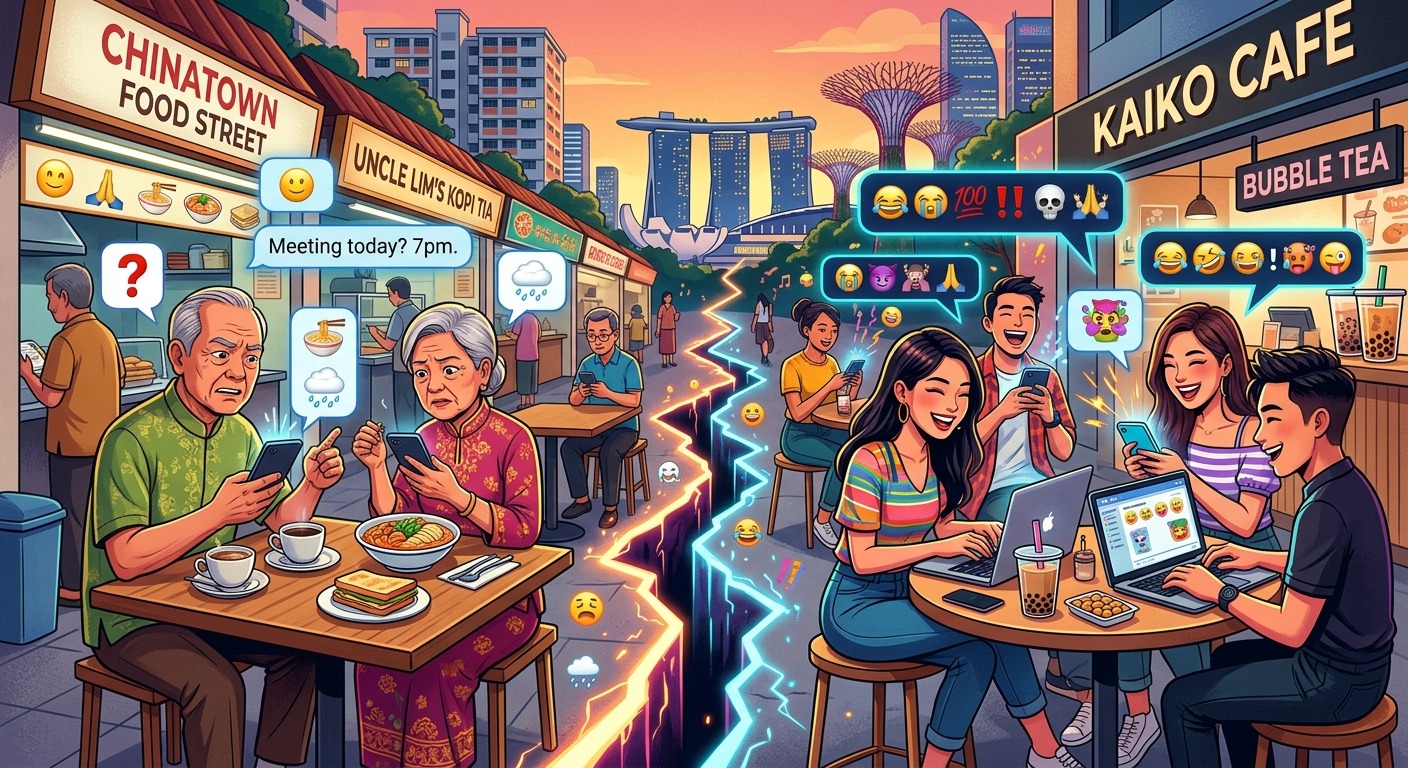
Open the average Singaporean’s phone and you will find at least two active group chats that use emojis in completely different registers.
The family Telegram group leans literal and enthusiastic. Birthday messages arrive in cascades of flowers, balloons, and red hearts. An aunt shares a news article and adds three exclamation marks and a shocked face. The emojis mean exactly what they look like. This is the register that older Singaporeans built their emoji fluency in, and many have stuck with it.
The work Slack channel, for younger professionals, operates on a different logic entirely. The skull emoji means something is hilarious. The loudly crying face is deployed for mock drama that is not actually sad. A string of sparkles around a statement that reads perfectly normal to an older eye might be a Gen Z signal of layered irony. These are not random deviations. They are a coherent second language.
Here are five contexts where this split plays out most visibly in Singapore:
- Slack and Teams channels: Younger employees receive thumbs-up reactions from managers and clock them as disengagement, while managers think they are being responsive and efficient.
- WhatsApp family groups: Emoji floods from older relatives feel warm and genuine to them, but can feel tonally overwhelming or hard to calibrate for younger family members.
- LinkedIn comments: Gen Z professionals often avoid emoji entirely on LinkedIn because they cannot calibrate which register is expected, adding another layer of professional silence.
- Project management tools: A clapping emoji reacting to a junior team member’s update can feel sarcastic to that person even when none was intended by the senior colleague who posted it.
- After-hours texts between colleagues: Tone in a non-work channel is even harder to read, and a single emoji choice can reshape how a message lands for hours afterward.
How Emojis Developed Their Own Subcultures and Shifting Norms
This meaning-shift did not happen overnight, and it did not happen randomly. There is a documented record of how specific symbols acquired new layers of use, particularly among younger digital communities in East and Southeast Asia, where emoji adoption intersected with existing visual communication cultures built around stickers, memes, and image-heavy messaging apps.
For readers who want to go deeper on how these symbols picked up so much cultural weight, an emoji culture blog maps precisely this kind of evolution, tracking how individual emojis acquire subcultural weight through viral moments, platform-specific communities, and generational usage shifts that consistently outpace the original design intent of any given symbol.
The core mechanism mirrors how slang works. A word starts with a plain meaning. A subculture adopts it with irony or affection. That ironic use spreads. The original meaning sits alongside it, held by older speakers who missed the shift. Both uses exist simultaneously, and the tension between them is where misreading happens.
Emojis do this faster than spoken slang because digital spread is instant, and because visual symbols are especially easy to strip from their original context and repurpose. Gen Z grew up in the middle of this accelerated churn. Their emoji fluency was formed inside that environment. Older generations built their fluency before the ironic registers arrived.
Why the Workplace Gap Feels Bigger Than It Should
In a family chat, a misread emoji produces a slightly awkward moment before the thread moves on. At work, the same misread accumulates. One thumbs-up reads as dismissive. Another does too. Over weeks, a junior employee starts reading their manager as detached or impossible to please. The manager has no idea any of this is happening.
This pattern matters more in Singapore than it might elsewhere because workplace hierarchies here carry more social weight. The emotional register between a junior employee and a senior one is already carefully managed. Adding an unreliable communication symbol to that register adds friction without anyone intending to create any.
How the Same Emoji Reads Across the Generational Divide
| Emoji | Gen Z / Younger Millennials | Older Millennials / Gen X / Boomers |
|---|---|---|
| 👍 Thumbs-up | Cold, dismissive, or passive-aggressive | Professional, affirming, task acknowledged |
| 😭 Loudly crying face | Playful, used for exaggerated mock drama | Genuine sadness or deep distress |
| 💀 Skull | Hilarious, “I’m dying laughing” | Alarming or unclear in meaning |
| 👏 Clapping hands | Sincere applause or ironic slow-clap, depending on tone | Sincere praise, always positive |
| ✨ Sparkles | Decorative, or used for passive-aggressive ironic framing | Purely decorative and cheerful |
The Silence That Keeps the Gap Open
Here is the thing nobody is actually saying out loud. Younger workers rarely correct their managers on emoji usage. It would feel presumptuous, maybe even rude. Managers, not knowing there is a problem, keep communicating the way they always have.
Raising it directly would require a junior employee to essentially tell a senior colleague that they have been reading as cold without meaning to. That is not an easy conversation in any culture. In Singapore, it is even harder. The friction of naming the issue feels larger than the friction of quietly living with it.
And so the gap persists. Not with any malice on either side. Just with the steady accumulation of small misreadings that nobody is quite sure how to address, layered on top of a communication environment that was already sensitive to begin with.
Reading the Room When the Room Keeps Changing
The generational divide in emoji use is not going to resolve itself through a company policy or a shared glossary. Nobody is circulating a guide to acceptable workplace emoji and expecting compliance from a 24-year-old who has been irony-posting since secondary school.
What might actually shift things is something simpler: a shared acknowledgment that the same symbol can genuinely hold different meanings depending on when you came online, which communities shaped your digital fluency, and which platform built your earliest sense of how tone works in text.
For younger workers, that might mean extending some grace to managers whose thumbs-up carries no dismissive intent. For older managers, it might mean noticing that a symbol they reach for automatically lands differently for the person on the other end of the notification.
Singapore is already a society that negotiates multiple registers of meaning every single day. People code-switch between English, Mandarin, Hokkien, and Malay within a single conversation without blinking. They read tonal cues across cultural contexts by instinct. Adding emoji fluency to that negotiation is, in some ways, just the next layer of a skill Singaporeans already carry.
The emoji is not the problem. The assumption that everyone reads it the same way is. In a city that has always known how to hold multiple truths at once, that assumption is one worth letting go.