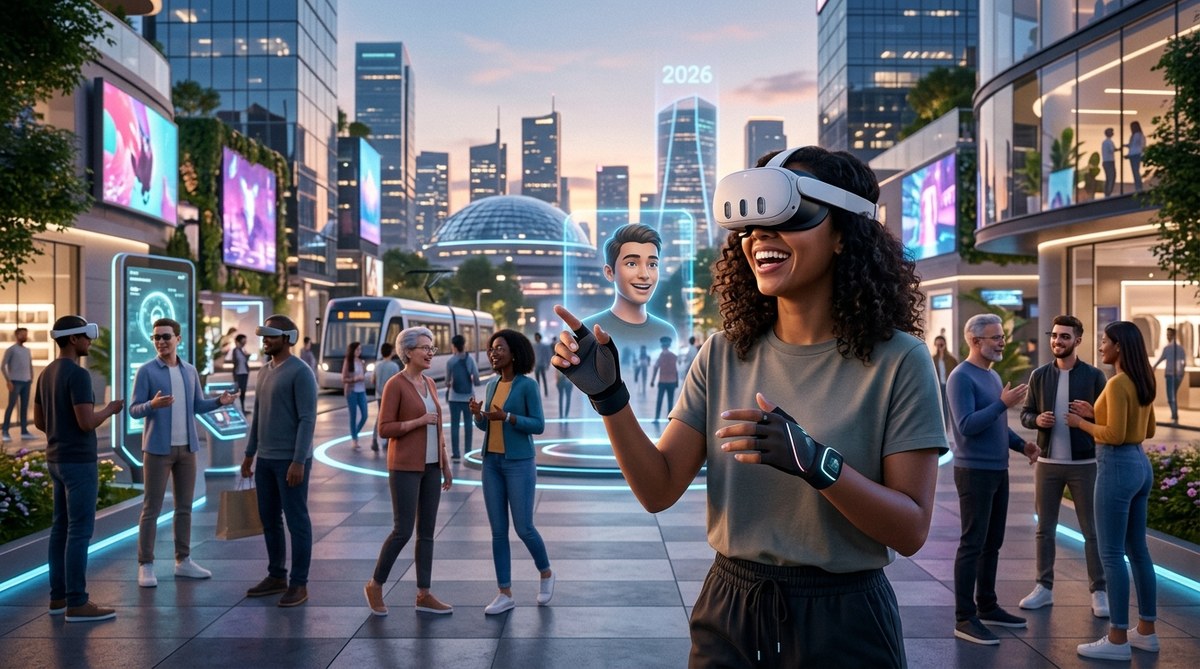
The metaverse hype cycle has been a wild ride. In 2021 everyone called it the next internet. By 2023 critics were writing obituaries for virtual worlds. Now in 2026, something is shifting. Not the breathless hype of five years ago, but real, measured progress. More people are clocking into virtual offices. Big brands are launching persistent storefronts. And hardware is finally catching up to the promises. So is this the year the metaverse cracks the mainstream? The answer is more nuanced than a simple yes or no. It depends on which metaverse you are talking about. The consumer social space is still finding its feet, but enterprise adoption is quietly skyrocketing. Let’s break down where we are, what’s changed, and what it means for the people building and investing in these worlds.
The metaverse is not dead, it has just shifted focus. In 2026 mainstream adoption is happening quietly in enterprise training, retail try-ons, and industrial simulations rather than flashy social worlds. Hardware prices have dropped, interoperability standards are emerging, and real revenue is flowing. For investors and marketers, the opportunity now is about utility, not hype.
Where the Metaverse Actually Works in 2026
The first question anyone asking about metaverse mainstream adoption 2026 should answer is: where are people actually using this stuff? If you only read headlines, you might think the whole idea fizzled out. But the data tells a different story. In 2026, the global market for enterprise metaverse solutions is projected to cross $110 billion, according to industry estimates. That’s not counting gaming or consumer social.
The biggest drivers are industrial training, remote collaboration, and digital twins for manufacturing. For example, companies like Siemens and Boeing now run maintenance simulations entirely in virtual spaces. Trainees learn complex procedures without touching expensive machinery. The return on investment is clear: fewer accidents, shorter learning curves, and less downtime.
Retail is also a strong use case. Ikea, Nike, and Sephora have all rebuilt their virtual try-on tools using spatial computing. Instead of clunky smartphone overlays, customers now step into shared 3D rooms where they can inspect a couch from every angle or test a foundation shade in real lighting. Adoption rates in 2026 are up 40 percent from last year. That is real conversion, not just curiosity.
Three Reasons Adoption Is Finally Accelerating
Why now? Three big factors are coming together in 2026.
First, hardware is less of a barrier. The price of a solid mixed reality headset has dropped below $400 for standalone devices. The Meta Quest 4 and Apple’s own headset (the one they finally shipped to consumers) both offer better ergonomics, longer battery life, and sharper passthrough for augmented reality. You still look a bit dorky wearing them, but the discomfort factor has drastically decreased. More people are willing to strap one on for a 30-minute meeting or a workout session.
Second, interoperability standards are gaining traction. The Open Metaverse Alliance (OMA) released its 2.0 protocol in early 2026, which allows avatars, digital assets, and identity credentials to move between platforms like Spatial, VRChat, and Decentraland. This kills a major friction point from earlier years. You no longer need separate accounts, wallets, and looks for every world. That seamless experience matters a lot for mainstream users.
Third, use cases have expanded beyond gaming. The early metaverse was almost entirely about playing Fortnite or building in Roblox. Those are still massive, but now corporate training, healthcare therapy, real estate tours, and even government town halls are taking place in shared virtual spaces. When a city council in Ohio held a zoning hearing in a digital town square last month and saw 300 residents attend, the value proposition clicked for a lot of skeptics.
What Real Success Looks Like Today
- Enterprise training: Walmart uses VR to train 1.5 million employees for Black Friday logistics. Retention rates are 75 percent higher than video training.
- Virtual commerce: Brands like Gucci and Patagonia sell digital only product lines that sync with real world purchases. In 2026, the virtual goods market hit $35 billion.
- Healthcare: Physical therapists are using VR to help stroke patients regain motor function. The sense of presence boosts motivation and recovery speed.
- Education: Over 12,000 schools in the US now have dedicated VR lab modules for science and history classes.
- Live events: Coachella, the Super Bowl halftime show, and the NBA All Star Game all offered premium virtual viewing experiences this year. Ticket sales for the digital tiers grew 60 percent compared to 2025.
These are not niche experiments. They are scaled operations with measurable outcomes.
Challenges Versus Solutions: A Reality Check
| Challenge | How 2026 Is Tackling It |
|---|---|
| High cost of headsets | Sub $400 devices and leasing programs for schools and businesses |
| Lack of useful content | Major brands and studios now producing native VR experiences, not just ports |
| Clunky interfaces | Eye tracking and hand gesture controls are standard in new models |
| Privacy concerns | New regulations in the EU and California force data localization and consent defaults |
| Fragmented platforms | OMA 2.0 protocol enables asset portability and single sign on |
| Motion sickness | Improved frame rates and foveated rendering reduce nausea for 90 percent of users |
As the table shows, the industry has moved past talking about these problems and is actively solving them. That does not mean everything is perfect, but the trajectory is clearly positive.
A Practical Framework for Evaluating Metaverse Adoption
If you are an investor or marketer trying to decide whether to commit resources, follow this five step process to assess viability in 2026.
-
Define your use case clearly. Is it branding, training, sales, or community building? Each one requires different platforms and metrics. Do not build a social space if you just need a digital showroom.
-
Test with a small pilot on two platforms that support OMA protocols. Run it for 90 days. Measure engagement time, conversion lift, and user feedback. Do not assume you understand the audience without data.
-
Compare the cost per interaction against your current channels. For example, a single IRL trade show booth might cost $80,000. A virtual equivalent can reach 10 times the attendees for a quarter of that budget.
-
Assess the hardware readiness of your target audience. If your customers are mostly 18 to 34, they likely already own a headset or are willing to try one at a pop up. For corporate clients, device leasing costs are tax deductible.
-
Iterate based on behavior. The most successful metaverse implementations in 2026 are those that update content weekly based on analytics. Static environments die. Dynamic ones thrive.
“The biggest mistake companies made in 2023 was treating the metaverse like a one time ad campaign instead of an ongoing channel. In 2026, the survivors are the ones that treat it like a physical storefront you have to maintain and restock.” says Rina Lo, CTO of Immersive Retail Partners, a consultancy that has helped deploy virtual showrooms for 14 Fortune 500 companies.
But What About the Consumer Metaverse?
You might be thinking: all that sounds like business stuff. What about hanging out with friends? Concerts? Digital nightlife? Those spaces are still around, but they have matured. Decentraland and The Sandbox saw their daily active users dip in 2024, but they have recovered by focusing on niche communities like digital art collectors and music festival superfans. Meanwhile, newer platforms like Dreamscape and Studio Null are attracting Gen Z with mobile first social hubs where you can hop into a 3D chat room from your phone without a headset.
The consumer metaverse in 2026 is not one giant world. It is hundreds of smaller, purpose built communities. That mirrors how the actual internet evolved from AOL chat rooms to millions of Discord servers. It works better that way. For marketers reaching these audiences, the trick is to embed your brand into existing spaces rather than trying to build your own from scratch.
Risks You Cannot Ignore
Of course, there are still landmines. Privacy regulations are tightening. In the US, the Virtual Spaces Data Protection Act (VSDPA) passed in late 2025, requiring explicit consent for biometric and movement data collection. Several companies have already been hit with fines for selling avatar motion data to advertisers. If you are entering this space, get legal counsel early.
Also, engagement fatigue is real. People only have so much time to spend in goggles. The average session for a consumer VR user in 2026 is about 40 minutes, mostly on weekends. Do not treat the metaverse as a replacement for your main website or app. Treat it as a complementary touchpoint.
What This Means for You in the Second Half of 2026
The metaverse is finally ready for mainstream adoption, but not in the form of a singular utopian world. It is ready as a set of practical tools that enhance how we work, shop, learn, and connect. The hype cycle has settled into a steady climb. For tech enthusiasts, this is the moment to jump in and experiment. For investors, look for companies with recurring revenue from enterprise contracts, not just speculation. For marketers, start with a targeted pilot, measure the heck out of it, and scale what works.
We are past the point of asking “Is the metaverse dead?” The real question now is “Which part of the metaverse actually makes sense for your goals?” The answers are becoming clearer every day. And if you want to stay ahead of the curve, now is the time to test a strategy, not wait for someone else to figure it out first.
If you found this analysis useful, you might also enjoy reading about how virtual reality is changing the way we experience digital culture. It covers the cultural shifts that make this technology feel so new to so many people. And if you are worried about data privacy in immersive environments, you will want to check out how digital privacy is evolving in the age of data monetization. Understanding the regulatory landscape is just as important as understanding the tech.