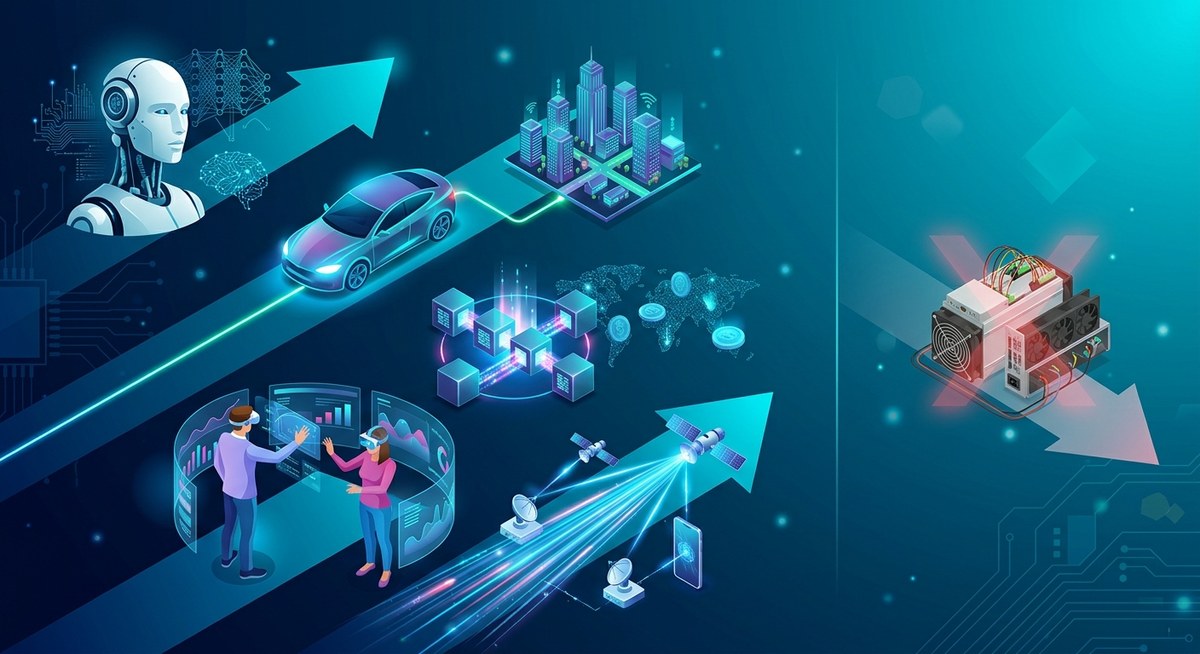
If you work in technology or lead a business, you probably feel it. The pace of change in 2026 is relentless. Every week brings a new breakthrough. A new promise. A new acronym to learn. But not every trend that gets headlines will actually matter. Some will reshape industries. Others will quietly fizzle out. This guide cuts through the noise. It covers the five tech trends that will dominate 2026 and explains why one heavily promoted trend simply will not take off. Use this as your roadmap for the year ahead.
In 2026, agentic AI will shift from demo to deployment, quantum computing will hit its first real commercial use cases, ambient intelligence will weave sensors into everyday spaces, polyfunctional robots will leave factory floors, and AI cybersecurity will become predictive. But the Metaverse, as originally promised, will continue to struggle outside niche enterprise applications.
## Agentic AI Goes From Demo to Daily Driver
The biggest shift in AI in 2026 is not a bigger model. It is autonomy. Agentic AI systems can plan, execute multi step tasks, and adapt without human hand holding. Think of them as digital employees that can book your travel, negotiate vendor contracts, or manage your cloud infrastructure. Companies like Salesforce and Microsoft are embedding these agents into their platforms right now.
A practical example: a sales team uses an agent to research leads, draft personalized emails, schedule follow ups, and update the CRM. All without a person copying and pasting. The agent fails gracefully when it hits a roadblock and asks for help.
This trend will dominate because the ROI is tangible. Here is how to evaluate agentic AI for your organization:
1. Identify three repetitive, rule based workflows that consume team hours.
2. Test a low risk agent with a small dataset for two weeks.
3. Measure time saved and error reduction before scaling.
4. Watch for vendor lock in. Choose platforms that let you switch models.
Internal links can help. If you are curious about how AI is reshaping creative work, read [how AI image generators are quietly reshaping creative industries](https://newnation.sg/how-ai-image-generators-are-quietly-reshaping-creative-industries/). It offers a different angle on the same underlying technology.
> “Agentic AI is not about replacing people. It is about removing the friction from processes that should never have required human attention in the first place.” – Dr. Lina Torres, Chief AI Strategist at NexusTech
## The Quantum Computing Tipping Point
Quantum computers have been “five years away” for decades. 2026 feels different. Hardware error rates have dropped enough that early commercial applications are emerging. Think drug discovery, supply chain optimization, and financial risk modeling. IBM and Google have both announced chips with over 1,000 logical qubits. That matters.
For business leaders, the practical impact will arrive in two forms:
– **Quantum as a service:** providers like Amazon Braket let you run hybrid algorithms without buying a machine.
– **Post quantum cryptography:** NIST standards are finalized, and companies must start migrating encryption by 2027.
The table below summarizes the key differences between classical and quantum computing relevant for 2026 decision makers.
| Aspect | Classical Computing | Quantum Computing (2026) |
|——–|——————-|————————–|
| Core unit | Bit (0 or 1) | Qubit (superposition) |
| Strength | Sequential logic | Parallel problem solving |
| Best for | Everyday apps, databases | Optimization, simulation, cryptography |
| Accessibility | Universal | Cloud only, limited queue |
| Cost per use | Predictable | Still premium but falling |
If the idea of quantum disrupting security concerns you, [how to prepare your digital life for the post-quantum era in 2026](https://newnation.sg/how-to-prepare-your-digital-life-for-the-post-quantum-era-in-2026/) steps through what to do now.
## Ambient Intelligence Gets Uncomfortably Personal
Ambient intelligence means technology that fades into the background. Sensors in your home, office, and car collect data and adjust environments automatically. 2026 is the year this becomes more than a novelty. Smart buildings can now detect occupancy patterns and adjust HVAC and lighting for energy savings. Retail stores use computer vision to track customer flow and optimize layouts.
But there is a catch. The same sensors that make life convenient also make surveillance easier. Privacy advocates are raising alarms. In 2026, companies deploying ambient intelligence must be transparent about data collection. Users are pushing back against hidden microphones and cameras in everyday objects.
Consider these points before adopting ambient intelligence:
– Audit every sensor. Know what data it collects and where it goes.
– Offer opt out clearly. A buried toggle in settings is not enough.
– Treat edge processing as a feature. Devices that process locally reduce risk.
For a deeper look at the listening side, [your smart home devices are listening more than you think](https://newnation.sg/your-smart-home-devices-are-listening-more-than-you-think/) covers the risks you might overlook.
## Polyfunctional Robots Step Into Real Life
Robots are no longer limited to welding cars on assembly lines. In 2026, polyfunctional robots combine manipulation, navigation, and basic decision making. They can restock shelves, deliver meals in hospitals, and even assist in construction. Boston Dynamics and newer players like Figure have shown robots that learn new tasks by watching a human once.
The shift is driven by cheaper sensors and better AI vision. A single robot can now swap between sweeping a warehouse floor and sorting packages. That flexibility makes the business case stronger. For small and medium businesses, robot as a service (RaaS) models lower the upfront cost.
A practical numbered process for evaluating robotics:
1. Identify a task that is repetitive, physically demanding, or prone to injury.
2. Check if a robot can handle it with minimal reprogramming.
3. Start with a pilot lease rather than a purchase.
4. Train your team to work alongside the robot, not replace them.
5. Measure worker satisfaction and output before expanding.
The trend aligns with a wider shift toward automation in everyday life. It is one reason [why your favorite apps keep adding features nobody asked for](https://newnation.sg/why-your-favorite-apps-keep-adding-features-nobody-asked-for/) is a worthwhile companion read. It explains the same impulse to add capability, even when not needed.
## AI Cybersecurity Goes Predictive
Reactive cybersecurity is no longer enough. In 2026, AI models predict attacks before they happen. They analyze network traffic, user behavior, and threat intelligence in real time. When something looks off, the system isolates the threat automatically. This is already cutting breach response times from days to minutes.
The main components of predictive AI security include:
– Behavioral baselines for every user and device
– Anomaly detection that adapts to new patterns
– Automated remediation (quarantine, reset passwords, alert admins)
– Continuous learning from global threat feeds
The benefit is huge. But there is a risk: false positives can lock out legitimate users. A well tuned system requires constant feedback loops. Human oversight remains essential.
For more on how your data flows in this ecosystem, [5 ways your data is being used without your consent and how to stop it](https://newnation.sg/5-ways-your-data-is-being-used-without-your-consent-and-how-to-stop-it/) offers practical steps.
## The Trend That Will Not Dominate in 2026: The Metaverse (As Originally Promised)
Remember the Metaverse hype of 2022 and 2023? Endless virtual worlds, digital real estate, meetings in VR. It did not happen. And in 2026, it still will not dominate. Why? The hardware is still bulky. The use cases remain narrow. Most consumers have no reason to put on a headset for daily tasks.
Instead, the Metaverse is quietly finding a home in specific enterprise niches: virtual training for surgeons, collaborative design for architects, and remote inspection for engineers. But the broad consumer adoption that Meta and others predicted is not materializing.
This does not mean VR and AR are dead. They are evolving into spatial computing. Apple’s Vision Pro showed a glimpse of that future. But the term “Metaverse” carries too much baggage. In 2026, the trend that will not dominate is the all encompassing, always on virtual world. If you are investing resources, focus on the five trends above instead.
## Looking Ahead: Practical Steps for 2026
The tech landscape in 2026 favors substance over hype. Agentic AI will deliver real productivity gains. Quantum computing will offer early commercial value. Ambient intelligence will reshape spaces but demand privacy care. Polyfunctional robots will extend automation. Predictive cybersecurity will become a necessity.
Start small. Pick one trend from this list and test it in your organization this quarter. Measure results. Learn from failures. Adapt.
Technology moves fast, but you do not have to chase everything. Focus on what actually changes outcomes. The rest can wait.