Your uncle just sent you a video of the President saying something outrageous. Your coworker shared a clip of a CEO announcing a surprise merger. Your friend is crying over a celebrity scandal that looks very real. In 2026, these moments happen every single day. And many of them are complete fabrications.
Deepfake technology has gotten scarily good. What used to require a team of animators and weeks of rendering can now be done with a single app on your phone. The results can fool almost anyone at first glance. But here is the truth: deepfakes are not perfect. They leave behind traces. You just need to know where to look.
This guide will teach you how to spot deepfakes with your own two eyes. No special software needed. Just a healthy dose of skepticism and a few practical tricks.
Deepfakes are easier to make than ever, but they still leave visual and audio clues. Focus on skin texture, eye movement, lip sync, and lighting mismatches. Compare the content against trusted sources. Use reverse image search tools. Stay skeptical of videos that trigger strong emotions. Your awareness is the best defense against digital deception.
What Makes a Deepfake So Tricky to Catch
Deepfakes use artificial intelligence to swap faces, mimic voices, or create entirely fake people. The technology has improved fast. In 2026, many deepfakes look flawless in a quick scroll. The danger is that they target your emotions. Fear. Anger. Excitement. When you feel a strong reaction, your critical thinking takes a back seat.
That is exactly what the creators want.
The most convincing deepfakes are the ones that confirm what you already believe. They play into your biases. So step one is simple: slow down. Take a breath. Then start looking for the cracks.
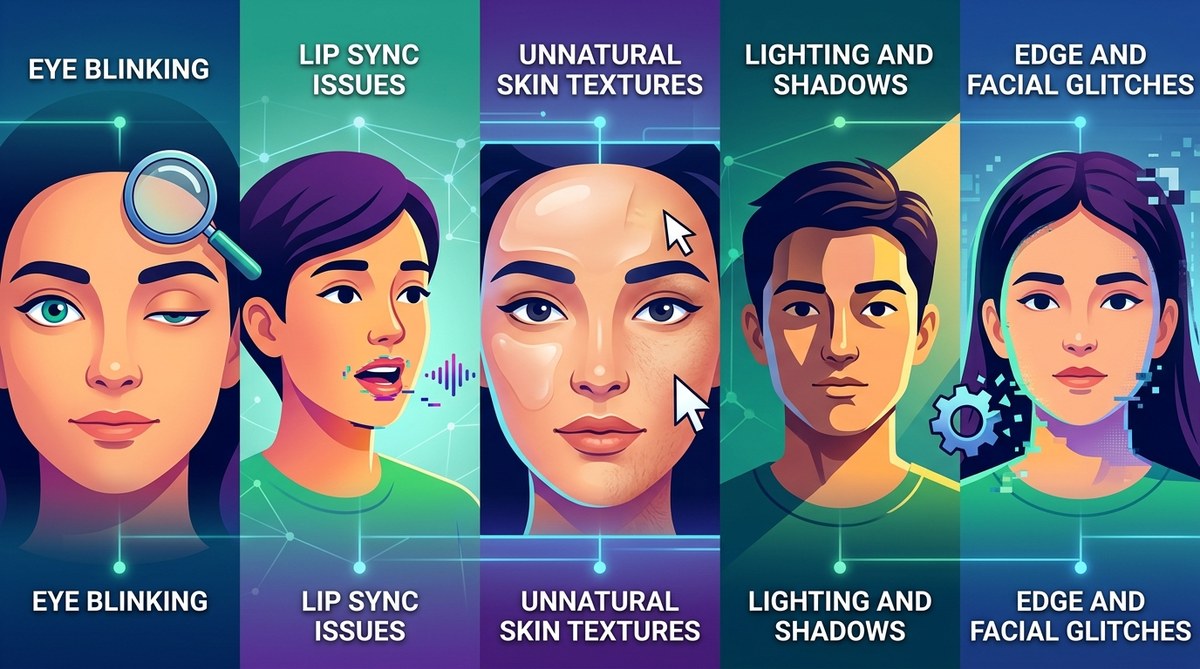
The 5 Visual Red Flags You Can Spot Right Now
These are the most reliable signs that a video has been manipulated. Train your eyes to look for them.
1. Strange skin texture and movement
Real skin has pores, fine lines, and natural imperfections. Deepfake skin often looks too smooth. It can have a waxy or plastic sheen. Watch the person’s face as they move. Does the skin stay perfectly smooth? Does it look like a filter is applied? Genuine skin shifts as muscles move underneath. Fake skin often stays static like a mask.
Pay close attention to the area around the mouth and cheeks. When someone talks, these areas move in complex ways. Deepfakes struggle to replicate that natural folding and stretching.
2. Eyes that do not look quite right
The eyes are a dead giveaway. Look at the reflections. Do both eyes have the same reflection of light? Real eyes catch light from the environment. Deepfakes sometimes miss this detail. One eye might have a reflection while the other does not. Or the reflections might not match the room.
Watch the blinking pattern. Natural blinking happens every few seconds. Some deepfakes make people blink too often or not enough. In rare cases, the person might not blink at all for an unnaturally long time.
3. Hair that behaves oddly
Hair is extremely hard to render convincingly. Look at the edges of the hairline. Do the strands look crisp or blurry? Deepfakes often soften the edges where the fake face meets the real hair. You might see a faint glow or blur around the hairline.
Also watch how hair moves when the person turns their head. Real hair has weight and momentum. It moves naturally with gravity. Deepfake hair sometimes floats or stays unnaturally still. It might clip through the face or shoulders.
4. Mismatched lighting and shadows
This is one of the easiest clues to spot. Look at the light on the person’s face. Does it match the light in the room? If the person is lit from the left but the background suggests light from the right, something is off.
Check the shadows under the nose and chin. These should match the direction of the light source. Deepfakes often create shadows that are too soft or in the wrong place. The fake face may have been recorded in different lighting than the background.
5. Unnatural mouth movements and teeth
Lip sync is getting better but it is still a weak spot. Watch the mouth carefully. Does the shape of the mouth match the sound you hear? Sometimes the mouth lags behind the audio. Sometimes it moves in ways that feel robotic.
Look at the teeth. Real teeth have subtle imperfections and slight transparency at the edges. Deepfake teeth often look unnaturally white and solid. They might appear as a single block rather than individual teeth. You may also notice that the inside of the mouth looks strange or lacks detail.
When the Audio Does Not Match the Face
Visual clues are important, but audio can reveal just as much. Listen for these signs.
Voice tone and pacing. Does the person sound like themselves? If you know the person’s voice, compare it. Deepfake audio can sound slightly robotic or flat. It might lack the natural breathiness and rhythm of real speech.
Background noise. Real videos have ambient sound. A room has a subtle echo. A car has road noise. Deepfake audio is often too clean. There is no background hiss or room tone. It sounds like it was recorded in a soundproof booth even though the video shows a crowded coffee shop.
Emotional mismatch. A person’s voice carries emotion. When someone is angry, their voice changes. When they are sad, it cracks. Deepfake audio often delivers words with the same emotional tone throughout. If the person is describing something shocking but their voice stays perfectly calm, that is a red flag.
A Handy Reference Table for Spotting Deepfakes
This table compares the techniques that work versus the mistakes people often make.
| Technique | What to Look For | Common Mistake |
|---|---|---|
| Examine skin texture | Waxy, over smoothed, no pores | Trusting HD resolution as proof of realness |
| Check eye reflections | Mismatched or missing reflections | Assuming both eyes are always identical in real life |
| Observe hair edges | Blur, glow, unnatural movement | Focusing only on the face and ignoring the hairline |
| Compare lighting | Shadows that contradict the background | Thinking lighting is too subtle to notice |
| Listen to audio | Robotic tone, missing background noise | Trusting clear audio as always real |
| Watch lip sync | Lag or mismatch between mouth and sound | Assuming high quality means perfect sync |
| Look at teeth | Too white, too solid, no detail | Ignoring the mouth area completely |
Expert Advice on Staying Ahead of the Fakes
“The best defense against deepfakes is not a tool. It is a habit. Pause before you share. Look at the video with a critical eye. Ask yourself: who made this and why? If the answer is unclear, treat it as suspect until proven otherwise. Deepfakes spread because we react faster than we think.”
Dr. Sarah Chen, digital forensics researcher at Stanford University
That advice cuts to the heart of the matter. The technology will keep getting better. But human habits can keep pace if we practice them.
Your Deepfake Spotting Checklist
Use this list as your mental checklist every time a video feels suspicious.
- Pause the video at a frame where the face is visible and still
- Look at the skin texture and check for that waxy look
- Examine both eyes for matching reflections
- Check the hairline for blur or unnatural edges
- Look at the lighting on the face versus the background
- Watch the mouth movements with the sound on and then muted
- Listen to the audio for robotic tone or missing background noise
- Use a reverse image search on a key frame of the video
- Search for the video claim on trusted news sites
- Ask yourself if the video triggers an emotional reaction designed to make you share
What to Do When You Suspect a Deepfake
You found something that looks fake. Now what?
First, do not share it. Sharing spreads the misinformation even if you add a warning. The video will still be seen by thousands of people who may not read your caption.
Second, report it. Most social media platforms have reporting options for manipulated media. Use them. It helps train their detection systems.
Third, check reliable sources. Go to a news outlet you trust and search for the same claim. If it is real, they will have covered it. If it is fake, they may have already debunked it.
Fourth, talk about it. Tell your friends and family what you found and how you spotted it. The more people know what to look for, the harder it becomes for these videos to spread.
If the deepfake involves someone you know personally, like a friend whose face was used without permission, offer support. Let them know you saw it and that you recognize it is not real. The emotional damage from being deepfaked can be significant.
Keeping Your Digital Senses Sharp in 2026
Deepfakes are not going away. They will only become more common and more convincing. That does not mean we should live in fear. It means we need to stay aware.
The same skills that help you spot a fake video also help you think more clearly about everything you see online. You become a better reader of media. You ask better questions. You rely less on gut reactions and more on careful observation.
Think of it like learning to spot a phishing email. At first it felt confusing. Now you notice the strange sender address or the bad grammar without even trying. Deepfake spotting works the same way. It becomes second nature with practice.
Start small. The next time a video makes you feel something strong, pause. Look at the skin. Check the eyes. Listen to the voice. You might be surprised at what you notice.
Your awareness is the one tool that no algorithm can take away from you. Use it. Share it. Teach it to someone else. That is how we beat the fakes together.
And if you want to go deeper into how AI is changing the media we consume, check out our piece on how AI image generators are quietly reshaping creative industries. Understanding the tech behind the fakes makes you even better at spotting them.