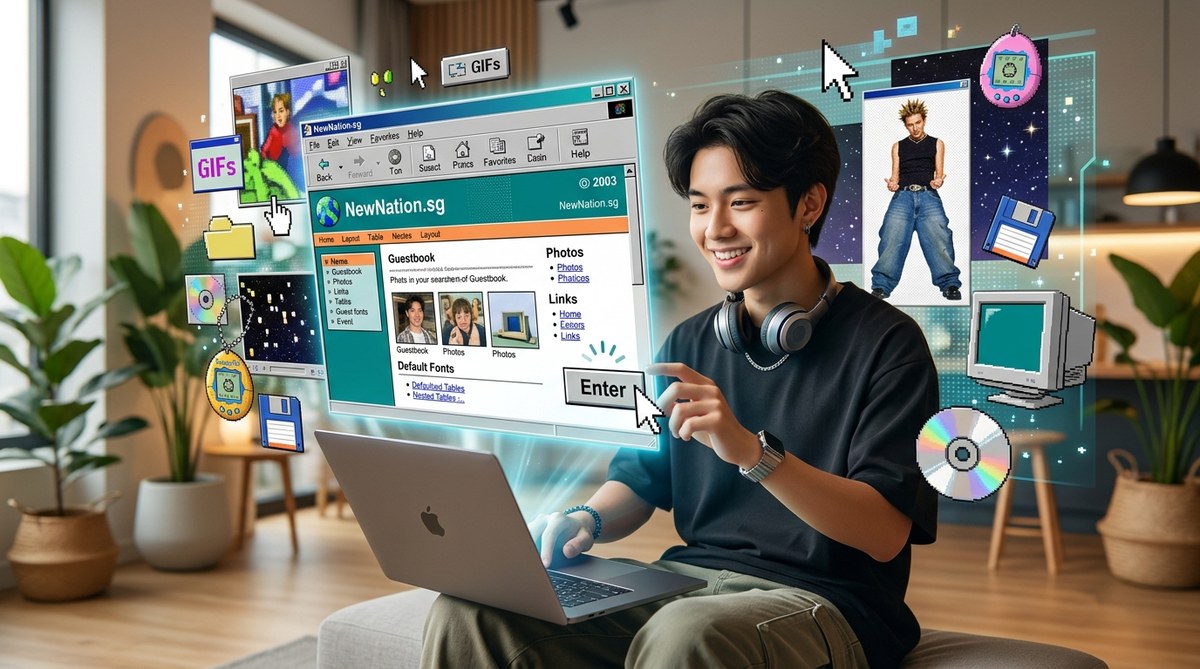
You might have noticed something weird happening across the internet in 2026. Websites are starting to look… old. Not outdated old, but intentionally retro. Pixelated GIFs, tiled backgrounds, construction worker icons, and text that sparkles or scrolls across the screen. That’s early 2000s web design nostalgia hitting a critical mass. And it’s not just a niche trend. Designers, brands, and everyday users are actively bringing back the aesthetics of the dial-up era. The movement is part of a larger cultural shift toward digital authenticity, a rebellion against the sterile, AI-generated sameness that has dominated recent years.
Early 2000s web design nostalgia in 2026 is more than a fad. It represents a longing for a simpler, more playful internet before algorithms and polished UX took over. By embracing Y2K elements like chaotic layouts, starry cursors, and guestbooks, creators are recapturing the raw creativity of the early web. This revival helps both Millennials and Gen Z reconnect with a version of the internet that felt personal and unpolished.
The Reason Behind the Y2K Web Revival
Why are people in 2026 suddenly craving the look of GeoCities and MySpace profiles from 2004? The answer lies in a collective exhaustion with the current state of the web.
For the past decade, design has been dominated by minimalism. Clean whitespace, sans serif fonts, and flat icons felt modern. But that approach has become a predictable formula. Every website looks like it was built from the same template. Add a layer of AI generated content and you get a web that feels hollow.
Early 2000s web design nostalgia offers an antidote. It’s messy. It’s personal. A handmade site from 2002 was a reflection of one person’s taste, complete with bad color choices, animated sparkles, and a hit counter that showed you were part of a small community. That authenticity is what people miss.
Many creators are turning to parallel trends like the unexpected comeback of forums and message boards in 2026 to recapture the same sense of belonging. The visual style is just the surface. The deeper draw is the feeling of creating something that isn’t optimized for engagement.
Key Design Trends Making a Comeback
Let’s break down the specific visual elements that define this revival. If you grew up on the early web, these will feel familiar.
Common Elements of the Early Web Revival
- Starry or animated cursors that follow your mouse
- Tiled background images, often repeating tiny patterns
- “Under construction” GIFs with animated construction workers
- Marquees that scroll text across the screen
- Guestbooks where visitors could leave messages
- Hit counters showing numbers like 000123
- Pixelated clip art and low resolution images
- Bright, clashing color schemes with no regard for accessibility
- Comic Sans, Papyrus, and other wildly overused fonts
3 Steps to Bring Early 2000s Web Aesthetics Into Your Next Project
If you want to ride the wave of early 2000s web design nostalgia in 2026, here is a practical process. You don’t need to rebuild your entire site. Just add a few touches.
-
Start with a splash page. Back in the day, many sites greeted visitors with a “splash page” that had a big logo, maybe an animation, and a link to enter. Make your own splash screen. Use a gaudy gradient background and a bold font. Keep it simple and over the top.
-
Add a guestbook or a fan wall. Nothing says early 2000s like a place for visitors to sign their name. Use a simple form that posts messages publicly. It encourages participation and gives your site a community feel. You can even include a “Friends” list with hyperlinked buttons.
-
Incorporate animated GIFs strategically. Place a few pixelated animations in corners or next to headers. A floppy disk saving animation, a dancing baby, or a blinking “NEW!” sign. Don’t overdo it. Two or three GIFs are enough to trigger nostalgia without overwhelming the page.
Y2K Web Design Techniques vs. Modern Mistakes
Some techniques from the early web are making a great comeback. Others are better left in the past. Here is a comparison table.
| Early 2000s Technique | Modern Mistake to Avoid |
|---|---|
| Animated cursors that are fun but optional | Using auto playing music that can’t be paused |
| Personal guestbooks for genuine interaction | Embedding third party chat widgets that slow load time |
| Unique handmade layouts with personal flair | Overusing generic templates that kill individuality |
| Low res images that were intentional pixel art | Accidentally serving unoptimized blurry photos |
| Marquees for decoration on personal pages | Running a marquee over critical navigation text |
Expert Advice on Embracing the Revival
“The early web was ugly in the best way. It was honest. Every site looked different because someone spent hours picking out a tiled background and writing HTML by hand. In 2026, that kind of handmade care feels subversive. I tell my students to break the rules of modern UX on purpose. Use a weird color scheme. Add a cursor trail. Let the site feel like it belongs to a person, not a corporation.”
— Mira Chen, digital culture writer and author of Rebooting the Web
Her point is crucial. The revival isn’t about copying the old mistakes. It’s about reclaiming the freedom those mistakes represented.
Why Gen Z and Millennials Both Love This Look
The appeal of early 2000s web design nostalgia in 2026 crosses generational lines, but for different reasons.
Millennials (ages roughly 30 to 45 in 2026) grew up on this stuff. They remember the sound of a dial up modem, the thrill of customizing a MySpace profile with CSS, and the hours spent building a GeoCities shrine to their favorite band. For them, the revival is pure nostalgia. It takes them back to a time before social media algorithms told them what to see.
Gen Z (ages roughly 14 to 29) didn’t really experience the early web firsthand. Most were babies or not yet born when GeoCities peaked. But they are drawn to the aesthetic because it feels fresh compared to the polished, conformist design of the 2020s. They also appreciate the anti corporate ethos. A site that looks handmade stands out in a sea of AI generated content. It signals that a human made it, and that matters.
This generation is also leading the broader movement of how nostalgiacore became the internet’s most powerful marketing tool. They want things that feel real, even if they have to rebuild them from scratch.
How to Get the Look Without Breaking the Internet
You don’t need to code everything from scratch. Several modern tools let you recreate early 2000s web design nostalgia in 2026 without compromising performance.
- Use a CSS framework like “NeoCities CSS” that provides ready made retro themes.
- Add a guestbook using a lightweight widget like “SpeakPipe” or a simple PHP script.
- Generate pixel art with apps like “Pixilart” or “Aseprite” and export as small GIFs.
- Host your site on platforms that allow custom HTML, such as Neocities or Netlify.
- Avoid Flash. It’s dead. Use modern JavaScript or HTML5 animations instead.
- Test on mobile. Many early web tricks break on small screens. Ensure your layouts still work.
A word of caution: don’t sacrifice speed. Early 2000s sites were slow because of dial up. In 2026, users expect instant loads. Optimize your images and limit the number of animations. The goal is a vibe, not a car crash.
What the Revival Says About Where We’re Going
Early 2000s web design nostalgia in 2026 is more than a superficial trend. It reflects a deep desire for the internet we used to have: one that felt small, personal, and weird. As platforms become more controlled and content becomes more uniform, the handmade web stands as a quiet rebellion.
If you are a designer, a blogger, or just someone who misses the old web, this is your chance to contribute. Add a starry cursor to your personal site. Start a guestbook. Use a font that would make a modern designer cringe. The rules are off. In 2026, the most radical thing you can do online is be yourself, one tiled background at a time.
So go ahead. Dig out those old GIFs. Fire up a text editor. Build something that feels like it belongs to you, not to an algorithm. The early 2000s are calling, and the answer is yes.