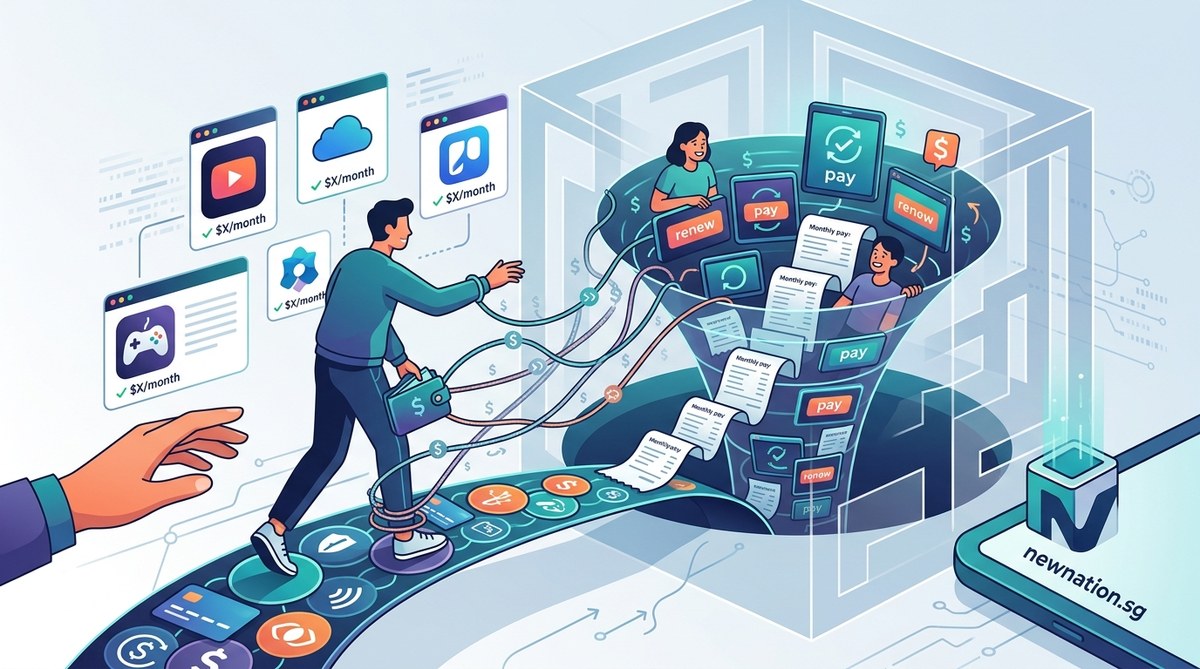
You signed up for Netflix during a weekend binge. Added Spotify because the ads were annoying. Grabbed Adobe Creative Cloud for one project. Before you knew it, your bank statement looked like a recurring payment festival, and you’re not even sure what half of these charges are for anymore.
The average person now spends $219 per month on digital subscriptions, but only actively uses 40% of them. This subscription trap happens gradually through free trials, auto-renewals, and forgotten services. By conducting a monthly audit, using virtual cards, and applying the 90-day rule, you can reclaim hundreds of dollars annually while keeping the services you actually value.
Why subscriptions feel invisible until they don’t
Subscription services are designed to disappear from your consciousness.
They charge small amounts. They bill on different days. They skip your inbox entirely when renewing. This invisibility is intentional. Companies know that the harder it is to notice a charge, the longer you’ll keep paying.
The subscription economy has grown 435% over the past nine years. What started with magazines and gym memberships now includes software, entertainment, food delivery, cloud storage, fitness apps, meditation guides, and even toothbrush heads.
Each service costs less than a dinner out. But together, they add up to a second rent payment.
The psychology behind why we can’t stop subscribing
Free trials are the gateway drug of the subscription trap.
You enter your credit card “just to try it.” The company banks on you forgetting the trial end date. Studies show that 42% of people forget they’re paying for subscriptions they no longer use.
Then there’s the sunk cost fallacy. You’ve already paid for this month, so you might as well keep it another month. And another. Before long, you’re paying for a service you haven’t opened in six months because canceling feels like admitting defeat.
Social pressure plays a role too. When everyone at work discusses the latest show on a streaming platform, you don’t want to be left out. When your friends share their workout stats from a fitness app, you feel pressure to join. The fear of missing out keeps wallets open even when budgets are tight.
“The subscription model works because it turns purchasing from an active decision into a passive default. You have to actively choose to stop, rather than actively choose to continue.” – Consumer psychology researcher
How to audit your subscriptions in under an hour
Most people have no idea how many subscriptions they’re actually paying for.
Here’s how to find out:
- Check your bank and credit card statements for the past three months
- Look for any recurring charges, no matter how small
- Search your email for terms like “subscription,” “renewal,” “payment received,” and “invoice”
- Review your app store purchase history on both iOS and Android
- Check PayPal, Venmo, and any other payment platforms you use
- List every subscription with its cost, billing frequency, and last time you actually used it
Set a timer for 60 minutes and work through this list systematically.
You’ll be surprised what you find. That language learning app you used twice in 2023. The cloud storage you signed up for when your phone was full. The premium version of an app that’s been free for years but you never downgraded.
The real cost of “just $9.99 per month”
Let’s break down what the average person is actually spending:
| Category | Average Monthly Cost | Annual Cost |
|---|---|---|
| Streaming video (3 services) | $45 | $540 |
| Music streaming | $11 | $132 |
| Cloud storage | $10 | $120 |
| Software subscriptions | $35 | $420 |
| Fitness/wellness apps | $25 | $300 |
| News and media | $15 | $180 |
| Gaming services | $18 | $216 |
| Food delivery memberships | $20 | $240 |
| Miscellaneous apps | $15 | $180 |
| Total | $194 | $2,328 |
That’s $2,328 per year on subscriptions alone.
For context, that’s a decent vacation. A used car. Three months of groceries. Or a significant chunk of an emergency fund that most people say they can’t afford to build.
Services designed to make canceling painful
Companies don’t make it easy to leave.
Some require you to call during business hours. Others hide the cancellation button behind multiple menus. A few make you explain why you’re leaving, guilt-tripping you with messages about what you’ll lose.
Adobe faced a lawsuit for making cancellation so difficult that it violated consumer protection laws. Planet Fitness became infamous for requiring in-person cancellations at the specific location where you signed up.
The tactics vary, but the goal is the same: create enough friction that you give up and keep paying.
Common cancellation obstacles include:
- Requiring phone calls instead of online cancellation
- Only allowing cancellation during specific hours or days
- Making you navigate through multiple “are you sure?” screens
- Offering discounts at the last second to keep you hooked
- Deleting your data immediately, so you can’t retrieve anything if you change your mind
- Charging early termination fees for “annual” plans you thought were monthly
The 90-day rule for new subscriptions
Before adding any new subscription, apply the 90-day rule.
Ask yourself: will I still be using this three months from now?
Not “might I use it.” Not “it would be nice to have.” Will you actually, realistically, open this app or service at least once a week for the next 90 days?
If the answer is anything less than a confident yes, don’t subscribe. Pay for a single month instead, or look for a one-time purchase option.
This simple filter eliminates impulse subscriptions. It forces you to think beyond the excitement of something new and consider your actual habits. Most of us overestimate how much we’ll use something and underestimate how quickly the novelty wears off.
Smart alternatives to subscription stacking
You don’t have to give up everything. You just need to be strategic.
Rotate your subscriptions. Subscribe to Netflix for two months, binge everything you want to watch, then cancel and switch to Disney+ for two months. Most content libraries don’t change fast enough to justify year-round subscriptions.
Share accounts legally. Many services offer family plans that cost only slightly more than individual plans. Split the cost with friends or family members. Just make sure you’re following the service’s terms of use.
Use free tiers. Spotify has ads, but it’s free. YouTube has everything you need without Premium if you can tolerate commercials. Many apps offer robust free versions that cover 90% of what most people actually use.
Buy instead of rent. For software you use daily, a one-time purchase often costs less over two years than a subscription. Check if the tools you need offer lifetime licenses.
Look for annual discounts. If you’re certain you’ll use something all year, annual plans usually save 15-20% compared to monthly billing. But only do this for services you’re absolutely committed to.
The rise of digital minimalism shows that many people are rethinking their relationship with digital services entirely, choosing to cut back rather than constantly add more.
Virtual cards are your secret weapon
Virtual credit cards let you create temporary card numbers for each subscription.
Services like Privacy.com, Revolut, or your bank’s virtual card feature let you set spending limits or create single-use numbers. When the free trial ends, the charge gets declined automatically. No awkward cancellation process needed.
You can also set monthly spending limits. Create a virtual card with a $10 limit for a service that costs $9.99. If they try to increase the price without warning, the charge fails and you get an alert.
This approach works particularly well for:
- Free trials you actually want to try but know you’ll forget to cancel
- Services with unclear pricing that might charge more than advertised
- Companies with bad reputations for customer service
- Any subscription you’re on the fence about
The psychological benefit is huge too. You’re no longer relying on your memory or discipline. The system handles it automatically.
What to do with subscriptions you actually need
Some subscriptions are worth keeping.
The ones you use daily. The ones that genuinely save you time or money. The ones that bring consistent value to your life.
For these, set calendar reminders to review them every six months. Not to necessarily cancel, but to check if:
- You’re still using them regularly
- The price has increased without you noticing
- A better alternative has emerged
- You can downgrade to a cheaper tier
- You’re paying for features you never use
Even good subscriptions deserve regular evaluation. Your needs change. Better options appear. What made sense last year might not make sense today.
Consider setting up a dedicated email address just for subscriptions. This keeps them organized and makes annual audits much easier. You can see every service in one place without digging through your main inbox.
The subscription trap isn’t about the money alone
Financial cost is only part of the problem.
Every subscription represents a small decision you have to make. Should I watch this or that? Which playlist should I choose? Do I need to back up these photos? These micro-decisions create mental clutter.
There’s also the data privacy angle. Every service collects information about you. Your viewing habits. Your location. Your contacts. Your photos. The more subscriptions you have, the more companies have pieces of your digital life.
Some people find that cutting subscriptions improves their screen time and sleep quality, simply because there are fewer apps competing for their attention.
When companies change the rules mid-game
Price increases are inevitable, but they’re rarely announced clearly.
A service that cost $9.99 when you signed up might now cost $14.99. That’s a 50% increase, but it happened gradually over three years, so you barely noticed.
Netflix started at $7.99 for streaming. Now their standard plan costs nearly double that. Amazon Prime has increased prices multiple times. Spotify, YouTube Premium, and nearly every major subscription service has raised rates.
Companies count on inertia. They know most people won’t cancel over a dollar or two increase. But those increases compound. And they never go back down.
Watch for these warning signs:
- Emails with subject lines like “Updates to our terms of service”
- New “premium” tiers that make your current plan feel inadequate
- Features moving behind higher-priced plans
- Ads appearing in previously ad-free experiences
- Reduced functionality in free tiers
Building a subscription budget that actually works
Treat subscriptions like any other budget category.
Decide how much you’re willing to spend per month on digital services. Maybe it’s $50. Maybe it’s $150. The number matters less than having a number at all.
When you hit that limit, you have to make choices. Want to try a new streaming service? Something else has to go. Interested in that productivity app? Which current subscription isn’t pulling its weight?
This forced prioritization prevents the slow creep of subscription accumulation. It turns each new subscription into an active trade-off rather than a passive addition.
Track your subscriptions in a simple spreadsheet:
- Service name
- Monthly cost
- Billing date
- Last used date
- Cancellation deadline (for annual plans)
- Notes on whether you’re actually using it
Update this once a month. It takes five minutes and can save you hundreds of dollars per year.
The future of the subscription economy
More companies are moving to subscription models every year.
Car features are becoming subscriptions. BMW tried to charge monthly for heated seats. Tesla sells performance upgrades as subscriptions. This trend will only accelerate.
Software that you used to buy once now requires monthly payments. Adobe. Microsoft Office. Even simple tools that used to cost $20 now want $5 per month forever.
The shift toward super apps means companies are bundling more services together, making it harder to pick and choose what you actually want.
Understanding these trends helps you make better decisions now. The subscription trap will only get more sophisticated. Companies are hiring behavioral psychologists to make their services stickier, their cancellation processes more frustrating, and their pricing more confusing.
Your best defense is awareness and systems. Know what you’re paying for. Build habits that keep subscriptions in check. Use tools that automate the hard parts.
Getting out of the trap and staying out
Start with the subscriptions you haven’t used in three months.
Cancel them today. Not tomorrow. Not after you “check one more time if there’s anything worth watching.” Today.
You’ll feel resistance. Your brain will generate reasons to keep them. Ignore that voice. You can always resubscribe later if you actually miss it. Spoiler: you probably won’t.
Next, tackle the ones you use occasionally. Could you live without them? Could you use a free alternative? Could you share an account instead?
Finally, optimize the ones you’re keeping. Make sure you’re on the right plan. Check if annual billing saves money. Set reminders to review them.
The subscription trap works because it’s designed to be invisible and painless. The way out is to make your subscriptions visible and your choices intentional. Your bank account will thank you, and you might find that you don’t actually miss most of what you cut.