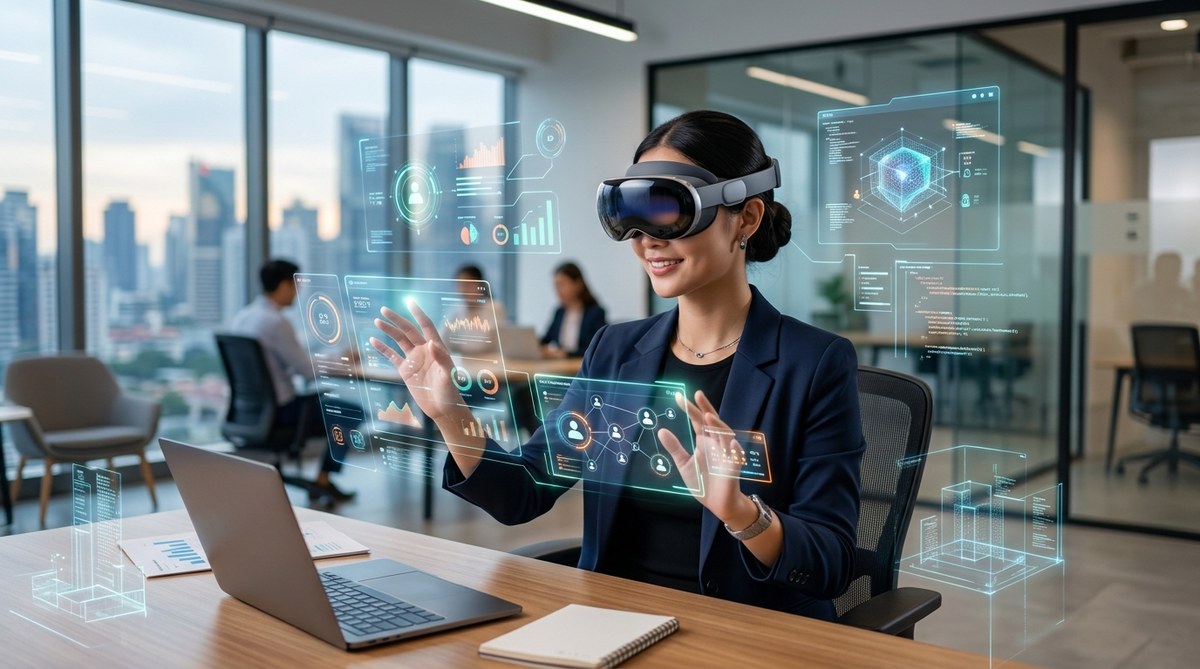
Apple just spent years building a headset that costs more than most laptops. Meta has poured over $36 billion into Reality Labs since 2019. Google quietly acquired North, a smart glasses company, and keeps filing patents for AR devices. Microsoft continues pushing HoloLens despite lukewarm enterprise adoption. The pattern is impossible to ignore. Every major tech company is racing toward the same finish line, and that line is drawn in three dimensions.
Spatial computing represents the next major computing platform shift, moving interfaces from flat screens into three-dimensional space around us. Tech companies are investing heavily now because the underlying technology (sensors, processors, batteries, displays) has finally matured enough to make practical consumer devices possible. This shift promises to change how we work, learn, shop, and interact with digital information in our physical environment.
The technology finally caught up to the vision
Virtual and augmented reality ideas have existed for decades. The difference today is that the hardware can actually deliver on the promise.
Modern processors can render complex 3D environments without draining batteries in minutes. Display technology has advanced to the point where pixels are small enough that your eyes can’t detect individual dots. Sensor arrays can track hand movements with millimeter precision. Cameras can map rooms in real time.
These weren’t possible five years ago at consumer price points. They barely worked in research labs.
The iPhone moment for spatial computing is happening right now. Just like smartphones needed better batteries, faster processors, and capacitive touchscreens before they could replace flip phones, spatial computing needed multiple technologies to mature simultaneously.
Follow the money to understand the urgency
Tech companies don’t invest tens of billions of dollars on hunches. They see clear market signals that justify the spending.
The smartphone market has plateaued. Global sales peaked in 2017 and have remained relatively flat since. People are keeping their phones longer. Upgrade cycles have stretched from 18 months to three years or more. Why your smartphone feels slower after every update explains some of the frustration driving this trend.
Companies need the next platform. They need a new category of device that people will buy every few years. Spatial computing is the most promising candidate.
The business model is familiar. Sell hardware. Take a cut of software sales. Collect data. Sell services. It’s the same playbook that worked for smartphones, but applied to a new form factor.
Three clear use cases are driving adoption
Spatial computing isn’t a solution looking for a problem. Three specific applications are pulling the technology forward.
Remote work and collaboration
Video calls are terrible for collaboration. You can’t gesture at a shared 3D model. You can’t walk around a virtual prototype together. You can’t have natural side conversations in breakout groups.
Spatial computing fixes these problems. Multiple people can inhabit the same virtual space, manipulate the same objects, and communicate with natural body language. Companies see this as the future of distributed teams.
Training and education
You can’t learn surgery from a textbook. You can’t master equipment repair from a video. Some skills require hands-on practice with realistic scenarios.
Spatial computing creates safe, repeatable training environments. Medical students can practice procedures on virtual patients. Technicians can train on expensive equipment without risking damage. The return on investment is clear and measurable.
Shopping and visualization
Returns cost retailers billions annually. Most returns happen because products don’t match expectations. The couch is too big. The paint color looks different. The appliance doesn’t fit the space.
Spatial computing lets customers see products in their actual environment before buying. Place a virtual sofa in your living room. See how that shade of blue looks on your wall in natural light. Check if the refrigerator fits between your cabinets. Fewer returns mean higher margins.
The platform war is already underway
Tech companies aren’t just building products. They’re building ecosystems. The company that establishes the dominant spatial computing platform will control the next decade of computing.
Here’s what’s at stake:
| Company | Strategy | Strength | Weakness |
|---|---|---|---|
| Apple | Premium hardware with tight integration | Developer ecosystem and brand loyalty | High price limits market size |
| Meta | Social experiences and advertising | Massive user base and VR experience | Privacy concerns and brand damage |
| Microsoft | Enterprise focus and productivity | Business relationships and Office suite | Consumer market weakness |
| Open platform and web integration | Search dominance and Android reach | History of abandoning hardware |
The winner will set standards for how spatial apps work. They’ll control the app store. They’ll define privacy norms. They’ll shape how billions of people interact with digital content.
That’s why the investment is so aggressive. Missing this platform shift would be catastrophic for any major tech company.
Consumer behavior is shifting in their favor
People are already comfortable with AR filters on social media. They use navigation apps that overlay directions on the real world. They play location-based games. They shop using virtual try-on features.
These small interactions are training wheels. They’re normalizing the idea of digital content existing in physical space. The leap to dedicated spatial computing devices is smaller than it seems.
Gaming is leading the way. VR headset sales have grown steadily. Beat Saber has sold over 4 million copies. Half-Life: Alyx proved that compelling VR experiences can drive hardware adoption. The gaming audience is already convinced.
Five steps companies are taking to prepare
Smart businesses aren’t waiting for spatial computing to arrive. They’re positioning themselves now.
-
Audit existing 3D assets. Many companies already have CAD models, product renders, and architectural plans. These can be repurposed for spatial applications with minimal modification.
-
Experiment with WebXR. Browser-based spatial experiences work on existing devices. They’re a low-risk way to test concepts and gather user feedback before investing in native apps.
-
Train teams on spatial design principles. Designing for three dimensions requires different skills than flat interfaces. Companies are upskilling designers and developers now.
-
Build partnerships with platform providers. Early access to development tools and featured placement in app stores goes to companies with existing relationships.
-
Identify high-value use cases. Not every business process benefits from spatial computing. Companies are focusing on applications where 3D visualization creates clear value.
What makes this different from past VR hype cycles
Skepticism is warranted. VR has been “the next big thing” multiple times before. The Virtuality Group tried in the 1990s. Second Life promised virtual worlds in the 2000s. Oculus sparked excitement in 2014.
This time feels different for specific reasons.
The technology actually works. Previous attempts failed because the hardware couldn’t deliver acceptable experiences. Motion sickness, low resolution, and clunky interfaces killed adoption. Modern devices have solved these problems.
Major companies are committed. When Facebook rebranded to Meta, they staked their entire corporate identity on this vision. That level of commitment drives sustained investment through the difficult early years.
Real businesses are seeing real results. Walmart trained over a million employees using VR. Boeing reduced training time for complex procedures by 75%. Surgical students who trained in VR performed 230% better than those who didn’t. These aren’t hypothetical benefits.
The infrastructure exists. Fast internet, cloud computing, and 5G networks can support the data requirements of spatial computing. Previous attempts happened before this infrastructure was in place.
Common concerns and honest answers
“Won’t this just make people more isolated?”
Potentially, yes. Like any technology, spatial computing can be used in ways that increase or decrease social connection. Video games can isolate people or connect them with communities. Social media can replace in-person relationships or enhance them. The technology itself is neutral.
The design matters enormously. Spatial computing platforms that prioritize shared experiences and real-world integration will have different social effects than platforms designed for solo escapism.
“Isn’t this just for gamers and tech nerds?”
Early adopters are always enthusiasts. The first smartphones were for business executives and gadget lovers. The first personal computers were for hobbyists. Mass adoption comes later, after the rough edges are smoothed and prices drop.
Current spatial computing devices are absolutely not ready for mainstream consumers. They’re expensive, uncomfortable, and limited. But that describes the iPhone in 2007 too. Give it five years.
“What about privacy and surveillance?”
Valid concern. Spatial computing devices have cameras and sensors constantly scanning your environment. They track where you look, how you move, and what objects surround you.
Companies will collect this data. They’ll use it to improve products, target advertising, and build profiles. The privacy implications are significant and largely unaddressed by current regulations.
This is worth paying attention to. The decisions made in the next few years will shape privacy norms for decades. Your smart home devices are listening more than you think covers similar concerns in a related context.
“Won’t I look ridiculous wearing a headset in public?”
Right now, yes. But social norms change. People thought Bluetooth earpieces looked absurd. Then AirPods became ubiquitous. Smartwatches seemed nerdy until they didn’t.
The form factor will shrink. Current headsets are bulky because the technology is early. Future devices will look more like regular glasses. At that point, the social stigma largely disappears.
The content problem that needs solving
Hardware is only half the equation. Spatial computing needs compelling content to drive adoption.
Right now, there’s a chicken-and-egg problem. Developers won’t invest in spatial apps until there’s a large user base. Consumers won’t buy devices until there are must-have applications.
Tech companies are trying to solve this by funding content creation. Meta has spent billions on VR game development. Apple is reportedly paying studios to create spatial experiences for Vision Pro. Microsoft subsidizes enterprise application development.
This strategy worked for previous platforms. Console makers fund exclusive games. Smartphone platforms paid developers to create apps. The same playbook applies here.
The breakthrough will come when someone creates a spatial computing experience that’s genuinely better than any alternative. Something you can’t do on a phone or computer. Something compelling enough that people buy hardware just to access it.
We haven’t seen that killer app yet. But the investment suggests companies believe it’s coming.
Key differences between AR and VR approaches
Spatial computing includes both augmented reality (adding digital elements to the real world) and virtual reality (replacing the real world with a digital one). Companies are betting on different approaches.
Augmented reality advantages:
- You stay aware of your surroundings
- Safer for extended use
- Works for productivity and daily tasks
- Lower computing requirements
Virtual reality advantages:
- Complete control of the environment
- More immersive experiences
- Better for entertainment and training
- Fewer real-world distractions
Most companies are hedging their bets with mixed reality devices that can do both. Apple’s Vision Pro, Meta’s Quest 3, and future devices from other manufacturers all support both AR and VR modes.
The market will likely split. Some applications work better in AR. Others require full VR. Successful platforms will support both seamlessly.
What this means for your business right now
You don’t need to buy headsets for your entire team tomorrow. But ignoring spatial computing entirely is risky.
Start by identifying processes that involve 3D visualization. Architecture, product design, medical imaging, real estate, interior design, and manufacturing all have obvious applications. If your business touches any of these areas, spatial computing will affect you.
Consider how your customers might benefit. Could they visualize your products in their space? Would virtual showrooms reduce friction in the sales process? Could training materials be more effective in 3D?
Watch what your competitors are doing. If they launch spatial computing initiatives and you don’t, they’ll have a head start when the technology reaches critical mass.
The investment doesn’t need to be massive. Small experiments now will teach you what works and what doesn’t. That knowledge will be valuable when spatial computing becomes mainstream.
The timeline is shorter than you think
Tech adoption follows predictable patterns. Enthusiasts buy first. Early adopters follow. Then the mainstream market arrives.
Smartphones took about five years from the iPhone launch to mainstream adoption. Tablets took three years. Smartwatches took longer, around seven years.
Spatial computing will likely fall somewhere in that range. Current devices are at the enthusiast stage. Early adopters will arrive in the next two to three years as prices drop and capabilities improve. Mainstream adoption could happen by 2030.
That sounds far away. It’s not. If you’re planning a product roadmap, building a new facility, or making long-term technology decisions, 2030 is well within your planning horizon.
Companies that start preparing now will have a significant advantage over those that wait.
Making sense of the spatial shift
Spatial computing represents the biggest change in how we interact with computers since the smartphone. Tech companies are investing heavily because the technology has matured, the market opportunity is enormous, and the competitive stakes are existential.
This isn’t hype. It’s a calculated bet backed by billions in investment and clear use cases. The devices available today are early and imperfect, but they’re good enough to prove the concept works.
You don’t need to become an expert overnight. But understanding why spatial computing matters now will help you make better decisions as the technology evolves. The companies that recognize this shift early will be the ones that benefit most when it arrives.
Start small. Experiment. Learn what works for your specific context. The spatial computing future is coming whether we’re ready or not. Being prepared beats being surprised.