
You’re reading a great article when suddenly, a wall appears. Subscribe for $15 a month or leave. This moment happens millions of times daily across news websites, and it’s reshaping how journalism works, who gets to read it, and whether quality reporting can survive.
Paywalls generate crucial revenue that supports [investigative journalism](https://www.journalism.org/) and quality reporting, but they also create information inequality by restricting access to those who can afford subscriptions. The debate centers on balancing financial sustainability for news organizations against the democratic principle that informed citizens need access to reliable information. Neither purely free nor fully paywalled models offer perfect solutions, pushing the industry toward hybrid approaches.
The case for paywalls saving journalism
Newsrooms have been bleeding money for two decades. Advertising revenue that once funded investigations, foreign bureaus, and local reporters evaporated as Google and Facebook absorbed 60% of digital ad spending.
Paywalls offered a lifeline.
The New York Times now has over 9 million paying subscribers. That money directly funds their newsroom of 1,700 journalists. Without subscription revenue, those positions wouldn’t exist. The investigations that exposed government corruption, corporate malfeasance, and public health crises wouldn’t happen.
Here’s what paywall revenue enables:
- Investigative teams that spend months on single stories
- Foreign correspondents reporting from conflict zones
- Specialized beats like science, education, and local government
- Fact-checking departments and editorial standards
- Legal teams to defend press freedom lawsuits
The Washington Post, The Atlantic, and The Wall Street Journal tell similar stories. Subscription models let them invest in journalism rather than chase clicks with celebrity gossip and viral nonsense.
“When readers pay for journalism, they’re voting for the kind of reporting they value. That direct relationship between audience and newsroom creates accountability that advertising never did.” – Former executive editor at a major metropolitan daily
Publications with paywalls can afford to say no to advertisers who want favorable coverage. They answer to readers, not corporate sponsors. That independence matters for credibility.
The accessibility problem nobody wants to talk about
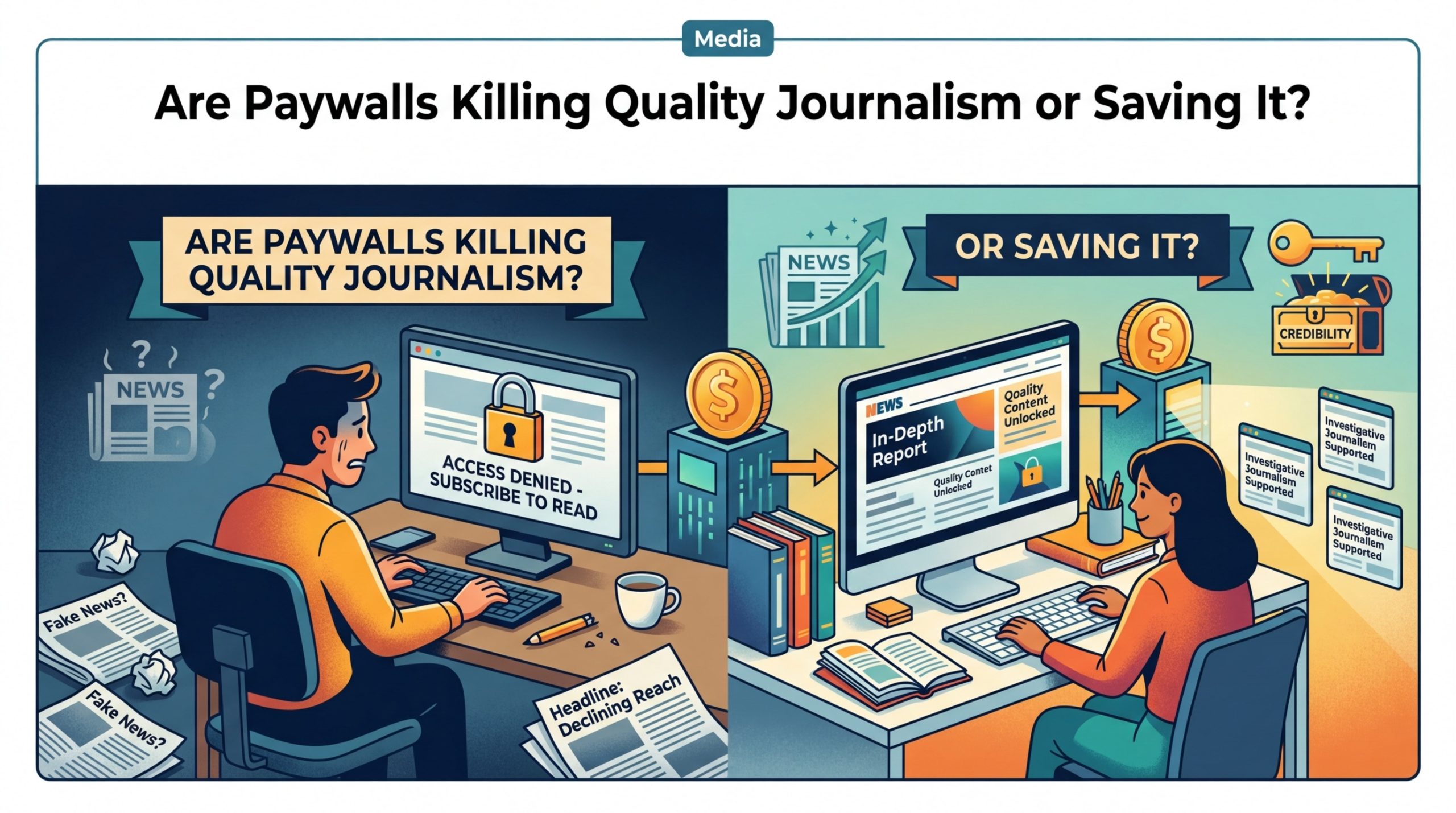
But here’s the uncomfortable truth: quality information is becoming a luxury good.
A household wanting access to national news, local reporting, and specialized coverage might need subscriptions to four or five publications. That’s $50 to $100 monthly. For families earning median incomes, especially those with kids in college or aging parents to support, that’s not realistic.
The result? Information inequality.
Wealthy, educated readers get unlimited access to investigative reporting, expert analysis, and verified facts. Everyone else gets whatever’s free, which increasingly means social media rumors, partisan blogs, and ad-supported content farms optimizing for outrage.
This creates serious problems:
- Democratic participation suffers when citizens can’t access quality information about candidates, policies, and local issues.
- Public health campaigns fail to reach people who most need accurate medical information.
- Communities facing environmental hazards or corporate exploitation lack resources to understand their situations.
Students writing research papers hit paywalls and turn to unreliable sources. Small business owners trying to understand economic trends can’t afford analyst coverage. Retirees on fixed incomes lose access to the local news they relied on for decades.
The irony stings. Journalism exists to serve democracy and hold power accountable, but paywalls restrict access to those who can already afford it.
What the data actually shows
Let’s look at what happens when publications implement paywalls versus when they stay free.
| Model | Quality Impact | Revenue Stability | Audience Size | Investigative Capacity |
|---|---|---|---|---|
| Hard paywall | High standards maintained | Predictable, growing | Dramatically reduced | Strong, well-funded |
| Metered paywall | Generally high quality | Moderate, variable | Reduced but broader | Decent funding |
| Freemium | Mixed quality tiers | Unstable | Large reach | Limited resources |
| Fully free | Declining standards | Collapsing | Maximum reach | Minimal to none |
Publications with successful paywalls produce more investigative stories, win more journalism awards, and maintain larger reporting staffs. That’s not opinion. Those are measurable outcomes.
But they also reach fewer people. The New York Times has 9 million subscribers in a country of 330 million people. Even accounting for shared subscriptions and library access, that’s a small fraction of potential readers.
Meanwhile, free sites with questionable standards reach tens of millions. They shape opinions and influence elections despite publishing misleading or false information.
The middle ground experiments
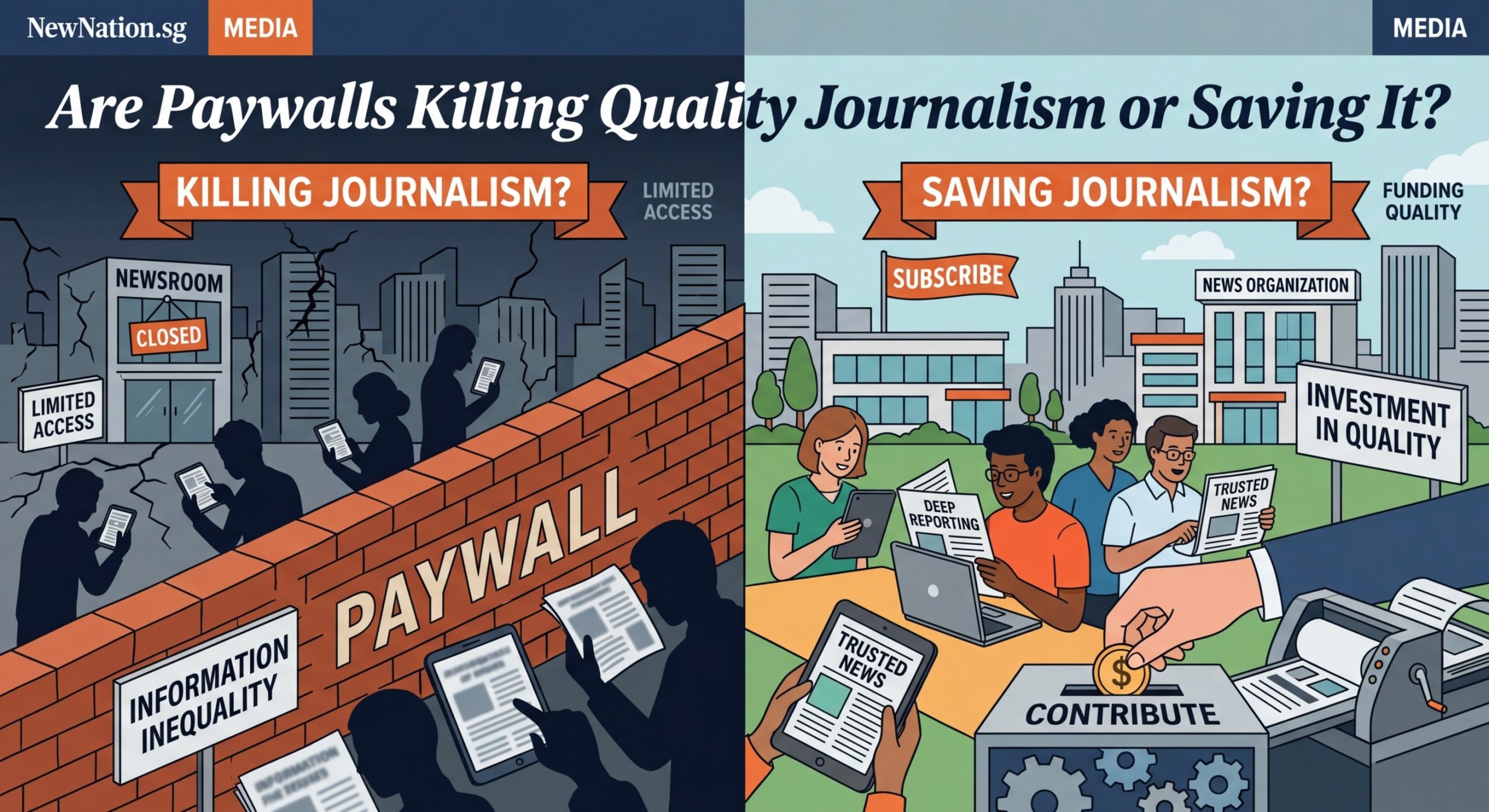
Some organizations are testing hybrid approaches that try to balance sustainability with access.
The Guardian uses a voluntary contribution model. Content stays free, but they ask readers to support journalism they value. This generated over $100 million annually, though it’s unclear if this scales or works long-term.
NPR combines public funding, corporate sponsorship, and individual donations. Their journalism reaches massive audiences through free distribution while maintaining editorial independence. But this model requires nonprofit status and ongoing fundraising.
Some local papers offer income-based subscription tiers. If you’re a student, senior, or low-income resident, you pay $3 monthly instead of $15. This preserves some accessibility while generating revenue.
Others provide free access to specific content categories:
- Breaking news and emergency information
- Local government and school board coverage
- Public health announcements
- Election and voting information
Investigative features, analysis, and specialized reporting stay behind paywalls. This attempts to serve democratic needs while funding quality journalism.
The real cost of free journalism
Here’s what happened to local news when the free model collapsed.
Between 2004 and 2020, the United States lost 2,000 newspapers. Newsroom employment dropped 57%. Entire communities now have zero local reporters covering city councils, school boards, or county commissioners.
The consequences are measurable:
- Municipal borrowing costs increase when local papers close because bond markets lack transparency
- Corruption rises in local government without watchdog coverage
- Voter turnout declines without information about local candidates
- Community engagement drops without shared information sources
Free, ad-supported models couldn’t sustain this coverage. The economics simply don’t work when Facebook takes the ad revenue but produces no journalism.
Publications that survived did so by implementing paywalls and refocusing on subscribers who value their work. They’re smaller, but they’re still reporting. Communities without paywalls lost journalism entirely.
Who actually benefits from each model
Let’s be honest about winners and losers.
Paywalls benefit:
– Journalists who keep their jobs and do meaningful work
– Affluent readers who get quality information
– Democracy at the national level where educated voters stay informed
– Shareholders and owners who see sustainable business models
Paywalls harm:
– Low-income families priced out of quality information
– Rural communities with limited local options
– Students and researchers needing broad access
– Democratic participation at local levels
Free models benefit:
– Maximum audience reach and democratic access
– Readers who can’t afford subscriptions
– Public awareness of breaking news and emergencies
– Social media platforms that profit from shared content
Free models harm:
– Journalists who lose jobs as newsrooms collapse
– Quality and accuracy as clickbait replaces reporting
– Long-term sustainability of news organizations
– Public trust as unreliable sources proliferate
Neither model serves everyone. Both involve tradeoffs between access and quality, reach and sustainability.
The future nobody’s sure about
Technology might offer solutions, or it might make everything worse.
Micropayment systems could let readers pay per article rather than committing to full subscriptions. You’d pay 25 cents to read one investigation instead of $15 monthly. This could work, but past attempts failed because transaction friction annoyed users.
Blockchain-based models promise to compensate journalists directly while maintaining free access. These remain mostly theoretical and face massive adoption challenges.
Aggregation services like Apple News+ bundle multiple publications for one fee. Readers get broad access, but revenue distribution often favors large publishers over local outlets that need support most.
Public funding models exist in many countries. The BBC, CBC, and similar organizations produce quality journalism without paywalls or advertising. American political polarization makes this approach controversial, with constant accusations of bias regardless of editorial independence.
Some analysts predict consolidation. A few major publications survive with paywalls while most journalism becomes nonprofit or publicly funded. Others foresee fragmentation into niche publications serving specific audiences willing to pay premium prices.
Nobody knows which future we’re heading toward.
Why this matters beyond media industry concerns
You might think this is just about newspapers and websites. It’s not.
The information ecosystem affects everything. Medical misinformation during pandemics. Election integrity. Environmental policy. Corporate accountability. Financial literacy. Community safety.
When quality journalism hides behind paywalls, misinformation fills the gap. When it’s freely accessible but poorly funded, accuracy suffers. Both scenarios damage public discourse and democratic function.
The question of whether paywalls help or harm journalism is really asking: how should society fund the information infrastructure that democracy requires?
Markets alone won’t solve this. Paywalls create sustainability for some outlets but exclude many citizens. Free models maximize access but can’t sustain quality reporting.
We need hybrid solutions combining subscription revenue, philanthropic support, public funding, and innovative business models. We need income-based pricing and free access to essential civic information. We need to treat quality journalism as infrastructure, not just another consumer product.
Making sense of an imperfect situation
Are paywalls good or bad for journalism? Both. They’re saving newsrooms while restricting access. They’re funding investigations while creating information inequality.
The real answer depends on what you value most. If quality and sustainability matter above all, paywalls work. If democratic access and maximum reach are paramount, they fail.
Most of us want both. We want excellent journalism that everyone can read. We want reporters paid fairly for essential work that serves the public. We want accountability journalism funded sustainably without excluding people based on income.
That’s not what paywalls alone deliver. But neither does any other current model.
The path forward probably involves accepting imperfect solutions. Supporting publications you value with subscriptions. Advocating for public library access to paywalled content. Pushing news organizations toward income-based pricing. Funding nonprofit journalism through donations. Demanding that essential civic information stays freely accessible.
Perfect solutions don’t exist yet. But understanding the tradeoffs helps us make better choices about which publications to support and how to structure access to information that democracy needs.