
You scroll through your feed during breakfast. A video about climate policy catches your eye. Then another post about the same topic appears. And another. Before you finish your coffee, you’ve seen five posts reinforcing the same viewpoint.
This isn’t coincidence. It’s algorithmic design.
Social media platforms use sophisticated systems to decide what content reaches your screen. These algorithms track every click, pause, and share to build a profile of your interests. The result? A personalized feed that feels custom-made for you.
But there’s a catch. When algorithms optimize for engagement, they often prioritize content that confirms what you already believe. Political posts that make you angry or excited get more visibility than nuanced policy discussions. Over time, this shapes not just what you see, but how you think about politics.
Social media algorithms curate political content based on engagement metrics, creating personalized feeds that often reinforce existing beliefs. These systems prioritize emotional reactions over balanced information, contributing to political polarization by showing users content that confirms their worldview while filtering out opposing perspectives. Understanding how these algorithms work helps users recognize bias in their feeds and seek diverse viewpoints.
What drives these algorithms
Social media platforms make money from your attention. The longer you stay on the app, the more ads you see. Algorithms are designed to maximize this time by showing you content you’re likely to engage with.
The system tracks dozens of signals. How long did you watch that political video? Did you like, comment, or share it? Did you click through to read the full article? Even the speed at which you scroll past a post sends information to the algorithm.
These data points feed into machine learning models that predict what you’ll find interesting. The algorithm doesn’t care about truth, balance, or democratic values. It cares about keeping you scrolling.
Political content performs exceptionally well under this model. Posts about controversial topics generate strong reactions. People comment to argue. They share posts that outrage them. All of this signals to the algorithm that political content is “engaging.”
The filter bubble effect
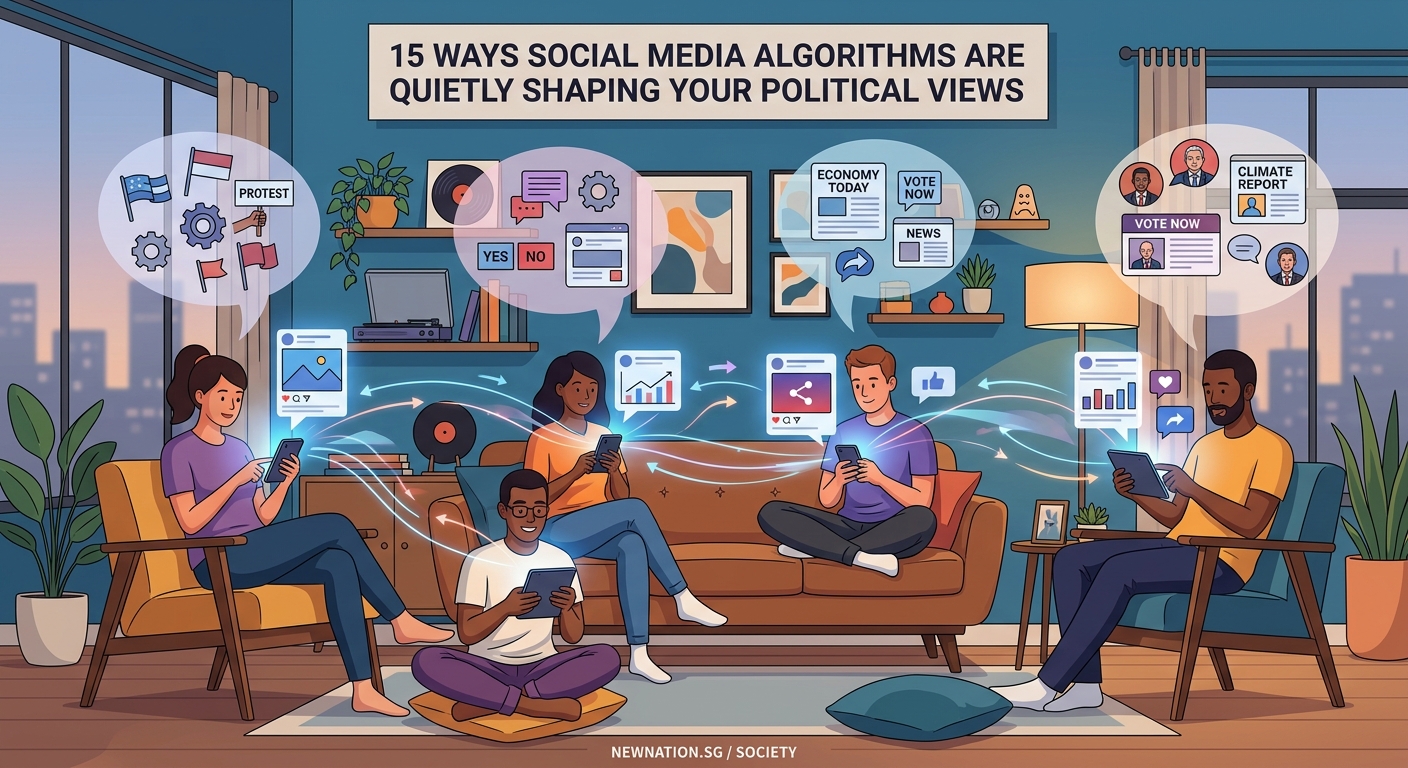
Your feed becomes a reflection of your existing views. If you interact with progressive political content, the algorithm shows you more progressive posts. Conservative users see conservative content. Moderates might see less political content altogether if they don’t engage with it.
This creates what researchers call filter bubbles. You’re surrounded by information that confirms your worldview while opposing perspectives disappear from view.
The effect compounds over time. As you see more content from one perspective, you engage with it more. This signals to the algorithm to show you even more similar content. The bubble grows stronger with each interaction.
Many users don’t realize they’re in a bubble. The content feels diverse because it comes from different accounts and covers various topics. But the underlying political perspective remains consistent.
How recommendation systems amplify extreme content
Algorithms don’t just show you more of what you like. They show you intensified versions of it.
If you watch a video about tax policy, the algorithm might recommend a more provocative video about government waste. If you engage with that, the next recommendation might be even more extreme. This pattern pushes users toward increasingly radical content.
Researchers have documented this radicalization pipeline across platforms. Moderate political interest can lead to exposure to extremist content through algorithmic recommendations. The system rewards content creators who produce emotionally charged material.
This happens because extreme content generates stronger engagement. A measured policy discussion might get a few likes. A inflammatory post about the same topic gets hundreds of shares and comments. The algorithm learns to favor the latter.
The role of engagement metrics

Platforms measure success through specific metrics:
- Time spent on platform
- Number of interactions (likes, comments, shares)
- Click-through rates on recommended content
- Return visits to the app
- Ad impressions and clicks
Political content excels at driving these metrics. A viral political post can keep users engaged for hours as they read comments, respond to arguments, and seek out related content.
The algorithm doesn’t distinguish between positive and negative engagement. Angry comments count the same as supportive ones. This incentivizes divisive content that sparks heated debates.
Content creators understand these incentives. Political influencers craft posts designed to trigger emotional responses. Nuanced analysis gets less visibility than provocative hot takes.
Different platforms, different effects
Each social media platform uses distinct algorithmic approaches that shape political discourse differently.
| Platform | Primary Signal | Political Impact |
|---|---|---|
| Friend interactions and group activity | Reinforces existing social networks; amplifies content shared by close connections | |
| Real-time engagement and retweets | Rewards viral, shareable content; favors breaking news and hot takes | |
| Visual appeal and saves | Prioritizes aesthetically pleasing political content; infographics perform well | |
| TikTok | Watch time and completion rate | Pushes short, emotionally resonant political messages; can expose users to diverse views |
| YouTube | Watch time and session duration | Creates recommendation chains that can lead to increasingly extreme content |
Understanding these differences helps you recognize how each platform might be shaping your political views. A political perspective that dominates your Facebook feed might be absent from your TikTok recommendations.
The personalization paradox
Personalization promises to show you content you care about. For politics, this creates problems.
Democracy requires exposure to different viewpoints. You need to understand why people disagree with you to engage in productive political dialogue. Algorithmic personalization works against this by hiding opposing perspectives.
The system assumes that content you don’t engage with isn’t valuable to you. But sometimes the most important information is what challenges your assumptions. Political posts that make you uncomfortable might be exactly what you need to see.
This creates a paradox. The more personalized your feed becomes, the less prepared you are to understand the full political landscape. You’re informed about issues that matter to you but blind to how others see the same issues.
How timing affects political content
Algorithms consider when to show you content. Political posts often get boosted during high-engagement periods.
Election seasons see dramatic increases in political content visibility. The algorithm detects rising interest in political topics and adjusts accordingly. Your feed becomes saturated with campaign content, polling data, and partisan commentary.
Breaking news triggers similar patterns. When a major political event occurs, the algorithm floods feeds with related content. This can be informative but also overwhelming. The rush to share breaking news often means less fact-checking and more misinformation.
Time of day matters too. Platforms know when you’re most likely to engage with political content. Morning scrollers might see news updates. Evening users might see more opinion pieces and commentary.
The spread of misinformation
Algorithms don’t verify truth. They measure engagement. Unfortunately, false information often generates more engagement than accurate reporting.
A study found that false news spreads six times faster than true news on social media. Misinformation triggers stronger emotional reactions, leading to more shares and comments. The algorithm interprets this as valuable content and shows it to more users.
Political misinformation is particularly problematic. False claims about voting, candidates, or policies can influence election outcomes. By the time fact-checkers debunk a viral false claim, millions of people have already seen and shared it.
Platforms have implemented fact-checking systems, but these work downstream from the algorithm. Content goes viral first, gets fact-checked later. The algorithmic boost happens before anyone verifies accuracy.
Echo chambers and political polarization
Research shows a clear connection between social media use and political polarization. People who get news primarily from social media hold more extreme political views than those who use traditional news sources.
The algorithmic echo chamber reinforces partisan identities. When you only see content from one political perspective, that perspective starts to seem like common sense. Alternative viewpoints appear not just wrong but incomprehensible.
This affects how you perceive political opponents. If your feed only shows the most extreme examples of the other side, you develop a distorted view of what they actually believe. Moderates on both sides get drowned out by algorithmic preference for extreme content.
The polarization feeds on itself. As people become more partisan, they engage more with political content. This signals to the algorithm to show them even more political posts. The cycle intensifies.
What you can do about it
Understanding how algorithms work is the first step. Here are practical ways to reduce their influence on your political views:
-
Actively seek out opposing viewpoints. Don’t wait for the algorithm to show you diverse perspectives. Follow accounts and publications from across the political spectrum.
-
Vary your news sources. Get political information from multiple platforms and traditional media outlets. This prevents any single algorithm from dominating your information diet.
-
Question your emotional reactions. When a political post makes you angry or excited, pause before engaging. Strong emotions are often what algorithms are designed to trigger.
-
Use chronological feeds when available. Many platforms offer options to see posts in time order rather than algorithmic order. This reduces the filter bubble effect.
-
Take regular breaks from political content. Constant exposure to algorithmically optimized political posts can skew your perception of reality.
-
Engage thoughtfully with content. The algorithm learns from your behavior. Liking nuanced, balanced content teaches it to show you more of the same.
“The algorithm is a mirror that shows you an increasingly distorted reflection of yourself. Breaking that mirror requires conscious effort to seek information that challenges rather than confirms your existing beliefs.” – Data scientist studying social media influence
The business model behind the bias
Social media companies face a fundamental tension. Their stated mission is often about connecting people and sharing information. Their business model requires maximizing engagement to sell ads.
This creates incentives that run counter to healthy political discourse. A platform that showed you balanced, nuanced political content would be less engaging than one that showed you outrage-inducing posts. Less engagement means less ad revenue.
Platform designers know this. Internal research at major social media companies has documented how their algorithms contribute to polarization. Yet changing the system would hurt their bottom line.
Some platforms have made adjustments. Facebook reduced the visibility of political content in feeds after user surveys showed people wanted less of it. But the underlying algorithmic logic remains focused on engagement.
The future of algorithmic influence
As artificial intelligence improves, algorithms will become better at predicting what content keeps you engaged. This could intensify the effects described here.
New technologies like generative AI could create personalized political content tailored specifically to your beliefs and triggers. Imagine political messages that feel like they were written just for you because, algorithmically, they were.
Regulation might change how platforms operate. Some countries are considering laws that require algorithmic transparency or give users more control over their feeds. Whether these efforts will succeed remains uncertain.
Platform competition could drive changes. If users migrate to services that prioritize healthy discourse over engagement, established platforms might adjust their algorithms. But so far, engagement-optimized platforms continue to dominate.
Why understanding this matters for everyone
You might think you’re immune to algorithmic influence. Most people do. Research shows that awareness of bias doesn’t necessarily protect you from it.
The effects are subtle. You don’t notice your feed gradually shifting toward more extreme content. You don’t realize that certain political perspectives have disappeared from your view. The algorithm shapes your information environment invisibly.
This matters for democracy. Informed citizens need access to diverse viewpoints and accurate information. When algorithms optimize for engagement instead of truth or balance, they undermine the information ecosystem democracy requires.
Your political views are shaped by what you see. What you see is increasingly determined by algorithms designed to keep you scrolling. Recognizing this influence is essential for making informed political decisions.
Taking back control of your feed
You can’t completely escape algorithmic influence while using social media. But you can reduce its impact on your political thinking.
Start by auditing your feed. Spend a week noting the political content you see. Is it balanced? Does it challenge your views or just confirm them? Are you seeing extreme content more often?
Then make deliberate changes. Follow accounts that offer different perspectives. Engage with content that makes you think rather than content that makes you angry. Use features that give you more control over what you see.
Remember that the algorithm learns from your behavior. Every like, share, and comment teaches it what to show you next. Be intentional about these signals. Reward the kind of political content you want to see more of.
The goal isn’t to avoid political content entirely. Staying informed about politics is important. The goal is to ensure that algorithms aren’t quietly deciding which political information reaches you and which gets filtered out.
Your political views should be shaped by careful thought and diverse information sources, not by systems optimized to keep you scrolling. Understanding how social media algorithms affect politics gives you the tools to reclaim that control.