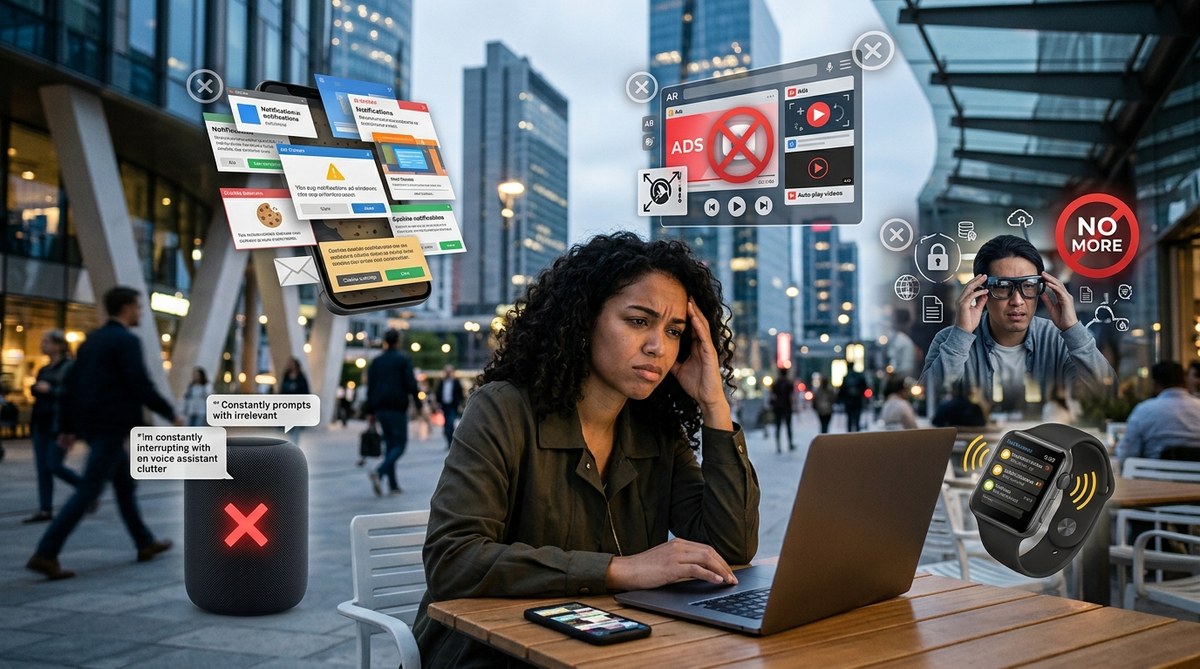
You open your laptop to edit a photo. Before you can crop anything, a pop-up asks you to subscribe to the “AI Enhance Suite” for $4.99 a month. You close the app, open a document, and are greeted by an assistant that rewrites your sentences before you finish typing. Your smart kettle just updated its firmware and now requires a login. This is the reality of technology in 2026, and it is exhausting. We are drowning in features we never asked for, paying for software we used to own, and being sold “innovation” that feels more like a tax on our attention. It is time to call out the noise.
The tech industry in 2026 is plagued by five major annoyances: AI crammed into every app, endless subscriptions for basic tools, planned obsolescence disguised as updates, the metaverse’s zombie-like persistence, and smart home devices that demand more than they deliver. Recognizing these trends helps you save money, protect your privacy, and reclaim your digital sanity.
The Great AI Bloatware Invasion
Remember when “AI” was a cool assistant that helped you find a restaurant? In 2026, it has become the unwanted guest at every digital table. Every app, from your calendar to your to-do list, now shoves a chatbot in your face. The problem is not artificial intelligence itself. The problem is that companies are bolting it onto products that worked perfectly well without it.
Take photo editing software, for example. You used to pay for a license to use a capable tool. Now, that same company charges you a monthly fee and forces an AI assistant into the workflow. It suggests “improvements” to your images that you did not ask for. It slows down the interface. It tries to upsell you on compute credits. It is bloatware dressed up as progress.
A recent survey by a consumer advocacy group found that 68% of users disable AI features within the first week of a new software update. That is a massive signal. People do not want their word processor to write their emails for them. They want a stable, fast tool.
Here is how to fight back against AI bloatware:
- Audit your apps. Open each one and check the settings. Look for a toggle to disable the AI assistant or “smart” features.
- Downgrade if possible. Some services still offer a “classic” or “legacy” view. Use it.
- Vote with your wallet. If a company forces AI on you, switch to a competitor that respects your choice.
- Use browser extensions. Tools like “Hide AI” can block pop-ups and sidebars in web apps.
- Read the update notes. If a “feature update” is really an AI bloatware install, skip it.
“Adding AI to a product that doesn’t need it is like putting a jet engine on a bicycle. It looks impressive in a press release, but it just makes the ride worse.” – Sarah Nguyen, UX designer and tech critic.
Subscription Fatigue and the Death of Ownership
The subscription model has jumped the shark. In 2026, you need a subscription for your car’s heated seats, a subscription to unlock the full power of your treadmill, and a subscription to edit a PDF. This is the most annoying tech trend of the year because it fundamentally changes the relationship between you and your property.
You used to buy a thing. It was yours. Now, you license the right to use it, and that license can be revoked. We broke down the costs in a piece about the subscription trap and how much you are actually paying for software every year, and the numbers are staggering. A family might pay over $200 a month for software, music, video, fitness, and cloud storage subscriptions.
| Trend | What It Looks Like | The Real Cost (Annual) |
|---|---|---|
| Software-as-a-Service | Adobe, Microsoft Office, Notion | $600 – $1,200 |
| Hardware Subscriptions | Car features, smart home locks | $200 – $500 |
| Content Bundles | Streaming services, news paywalls | $1,000 – $1,800 |
| Wellness Tech | Peloton, meditation apps, sleep trackers | $300 – $700 |
The solution is to embrace the “buy once” philosophy. Look for software that offers a perpetual license. Support companies that sell hardware without a mandatory service plan. And be ruthless about canceling subscriptions you do not use monthly. Set a calendar reminder to review every subscription every three months.
Planned Obsolescence Disguised as Security Updates
Your phone worked fine last week. Then you installed the “critical security update.” Now the battery drains in four hours, the animations stutter, and the fingerprint sensor is laggy. This is not a bug. It is a feature for the manufacturer.
In 2026, the excuse of “security” is used to push updates that intentionally degrade older hardware. The goal is to make you feel that your device is unsafe unless you upgrade. This practice is especially frustrating because it targets the most vulnerable users who cannot afford a new flagship phone every two years.
We wrote about why your smartphone feels slower after every update and what you can actually do about it. The short answer is that you can delay updates. You do not have to install the latest version on day one. Wait a month. Read forums. If users report performance issues, skip that version.
A few strategies to fight planned obsolescence:
- Disable automatic updates. Turn them off in your system settings.
- Use third-party firmware. For some devices, community-built operating systems offer longer support.
- Repair, do not replace. A new battery can give an old phone years of extra life.
- Buy from companies with a right-to-repair policy. Support brands that publish repair manuals and sell spare parts.
The Metaverse Refuses to Die
The metaverse was supposed to be the next big thing. In 2026, it is the next annoying thing. Tech giants are still pouring billions into virtual real estate, digital avatars, and VR headsets that nobody asked for. The problem is that they are trying to force it into every aspect of our lives.
Your work chat app now has a “3D office” feature. Your social media feed is cluttered with promoted posts about virtual concerts. Your bank wants you to visit its virtual branch. It is a solution in search of a problem. The average person does not want to put on a headset to check their email. They want to sit on a couch and scroll on a phone.
The metaverse trend is annoying because it represents a disconnect between what Silicon Valley wants and what people need. It is a distraction from real problems like privacy, data security, and accessibility. When you see a “metaverse” feature, treat it as noise. Disable it. Ignore it. The faster we stop engaging with these virtual worlds, the faster companies will stop building them.
Smart Home Devices That Are Not So Smart
Your smart home should make life easier. In 2026, it often makes life harder. The biggest offender is the smart appliance that requires a constant internet connection. Your refrigerator should not stop making ice because the company’s server is down. Your light bulbs should not require a login to turn on.
The rise of the “smart” device has created a new category of frustration: the bricked gadget. When a company goes out of business or decides to discontinue support, your expensive device becomes a paperweight. We discussed this in our article on what happens when your smart car manufacturer goes out of business, but it applies to every connected device.
Here is a checklist to avoid buying a problematic smart home device:
- Does it require a cloud account to function?
- Can it be used fully offline?
- Is the company profitable and likely to survive?
- Are there open-source firmware alternatives?
- Does it have a physical control (button, knob, switch)?
If the answer to any of these questions raises a red flag, skip the purchase. The best smart home device is one that works reliably without demanding your attention.
How to Spot the Next Annoying Trend Before It Wastes Your Money
You can avoid most of these frustrations by being a skeptical consumer. Before you buy a new gadget or subscribe to a new service, ask yourself three questions.
- Does this solve a real problem? Be honest. Do you need a smart water bottle that tracks your sips? Probably not.
- What is the long-term cost? Factor in subscriptions, replacement parts, and the time you will spend setting it up.
- Can I walk away? If the company disappears tomorrow, does the device still work? If not, it is a liability.
The tech industry will keep pushing these trends because they are profitable. Your job is to protect your wallet, your time, and your sanity.
A Smarter Path Forward in 2026
The most annoying tech trends of 2026 share a common thread: they prioritize corporate growth over user experience. AI bloatware, subscription traps, planned obsolescence, the zombie metaverse, and needy smart devices all demand more from you while delivering less.
The good news is that you have power. You can choose not to engage. You can buy from companies that respect your ownership. You can disable features that do not serve you. You can embrace the rise of digital minimalism and focus on tools that actually improve your life.
Next time a pop-up asks you to subscribe to an AI feature, click “No thanks.” Next time an update promises to make your phone “smarter,” wait a month. Next time a smart appliance demands your email, put it back on the shelf.
Tech should serve you. Not the other way around. By rejecting these trends, you send a clear message to the industry. Build better products. Or get left behind.