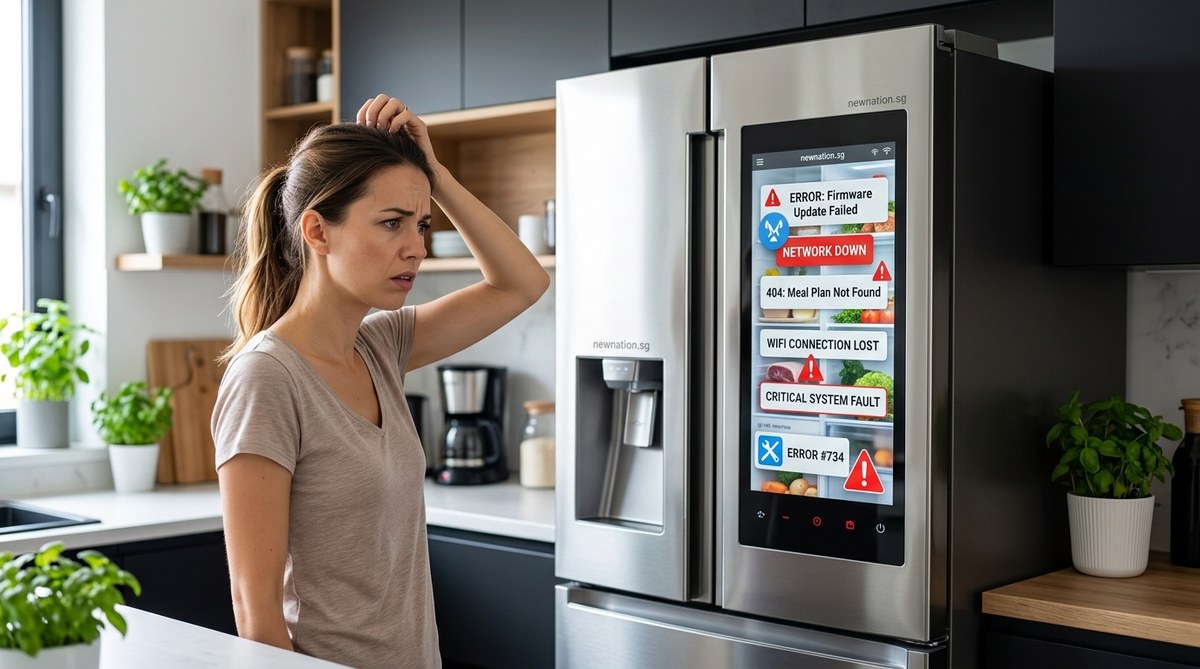
You dropped over two grand on a smart fridge. It has a giant touchscreen on the door. It can show you the weather, play Spotify, and even remind you to buy milk. For the first week, it felt like living in the future. Then the screen started lagging. The milk reminder went off even though you had three cartons inside. And the ice maker stopped working because a software update broke the calibration.
If that sounds familiar, you are not alone. Smart fridge problems are everywhere, and most of them have nothing to do with keeping food cold. The truth is, these appliances are packed with features that sound great on paper but fall apart in real life. Here is why your smart fridge is probably dumber than you think and what you should know before buying one.
Smart fridges promise convenience but often deliver frustration. Common problems include buggy software that lags or crashes, serious security vulnerabilities that expose your home network, and expensive repairs when proprietary parts fail. Many features, like grocery tracking and recipe suggestions, require constant manual input to work correctly. Before you upgrade, understand that a smart fridge is basically a tablet glued to a refrigerator, and it inherits the flaws of both devices.
The Software Problem No One Warns You About
Most smart fridges run a stripped-down version of Android or a custom Linux build. That sounds fine until you realize these operating systems rarely get updates after the first year. Manufacturers treat software like an afterthought. They ship the fridge, collect your data, and move on to the next model.
Here is what that means for you:
- The touchscreen interface becomes slow and unresponsive over time.
- Apps like Spotify or Instacart stop working when the manufacturer stops supporting them.
- The fridge’s internal computer can freeze, forcing you to unplug the whole unit to reset it.
- Critical updates that fix bugs or security holes never arrive.
This is not a rare issue. A 2025 survey from Consumer Reports found that nearly 40 percent of smart appliance owners reported software-related malfunctions within two years of purchase. Compare that to a standard fridge, which might run for a decade without a single software problem. The difference is stark.
Security Risks That Go Beyond Annoying Glitches
Your smart fridge connects to your home Wi-Fi. That means it is a computer on your network. And like any computer, it can be hacked. Security researchers have demonstrated multiple times that smart fridges can be compromised. In 2024, a team at a major cybersecurity conference showed how a popular smart fridge model could be used to steal login credentials for other devices on the same network.
The problem is that fridge manufacturers are not security companies. They do not patch vulnerabilities regularly. They do not offer bug bounty programs. And they certainly do not encrypt data the way your bank or email provider does.
Consider this table of common smart home security risks:
| Device | Risk Level | Common Issue | Update Frequency |
|---|---|---|---|
| Smart fridge | High | Unencrypted data transmission | Rarely updated after 1 year |
| Smart thermostat | Medium | Weak default passwords | Updated every 3 to 6 months |
| Smart speaker | Low to Medium | Microphone always listening | Regular updates |
| Smart lock | High | Remote access vulnerabilities | Depends on brand |
Notice the pattern. Smart fridges are among the least secure devices in your home. They sit on your network, quietly sending data to servers you do not control, while receiving almost no security patches. If you care about privacy, this should concern you.
The Grocery Tracking Feature Is Basically Useless
One of the biggest selling points for smart fridges is the ability to track your groceries. The idea is simple: the fridge scans what you put inside, keeps an inventory, and tells you when you are running low. In practice, this feature is a complete mess.
To make it work, you have to manually log every item you put in the fridge. Some models have internal cameras, but they cannot tell the difference between a carton of eggs and a block of cheese. You still have to use the touchscreen or a phone app to tell the fridge what you added. And if you forget to log something, the inventory becomes wrong. Within a week, the system is so inaccurate that you stop using it altogether.
The same goes for expiration date tracking. The fridge cannot read the date on your milk carton. You have to enter it yourself. At that point, you might as well use a simple notes app on your phone. The fridge adds zero convenience.
Repairs Cost a Fortune Because Everything Is Proprietary
A regular fridge breaks, you call a repair person, and they fix it with standard parts. A smart fridge breaks, and you are at the mercy of the manufacturer. The touchscreen, the control board, the Wi-Fi module, and the internal computer are all custom parts that only the brand can supply.
Here is a numbered list of what happens when a smart fridge needs repairs:
- The fridge stops cooling, but the screen still works. The repair person tells you the main control board is fried. It is a proprietary part that costs $400.
- You call the manufacturer. They say the part is backordered for six weeks.
- You spend six weeks with a cooler full of ice and a growing pile of spoiled groceries.
- The part finally arrives. The repair costs $600 total, including labor.
- Six months later, the touchscreen stops responding. Another proprietary part, another expensive repair.
This is not hypothetical. Stories of expensive smart fridge repairs are common on forums like Reddit and Consumer Affairs. The worst part is that many of these failures are caused by software bugs, not mechanical wear. A standard fridge from the 1990s is still running because it has no software to break. Your smart fridge might not last five years.
Planned Obsolescence Is Built Into the Design
Manufacturers want you to buy a new fridge every few years. That is why they design smart fridges to become obsolete. When the software stops being updated, apps stop working, and the screen becomes a useless brick. You are left with a perfectly good refrigerator that has a broken tablet glued to the front.
Some brands have already started charging subscription fees for advanced features. Want to use the grocery tracking app? That will be $10 a month. Want remote temperature control? That is another $5. The fridge you bought for $3,000 now requires a monthly payment to work as advertised.
This is the same trap that printer companies have been using for years. Sell the hardware cheap (or at a premium), then charge for the software that makes it useful. Smart fridges are following the exact same playbook.
What to Do If You Already Own a Smart Fridge
If you are stuck with a smart fridge that is causing headaches, there are a few things you can try before replacing it.
- Disconnect it from Wi-Fi. Most smart fridges will still cool food perfectly fine without internet access. You lose the smart features, but you also eliminate the security risks and the laggy screen issues.
- Check for manual firmware updates. Some manufacturers post updates on their website that you can install via USB. It is rare, but worth a shot.
- Disable the touchscreen if possible. Some models have a setting to turn off the screen entirely. This saves power and reduces frustration.
- Use a third-party temperature monitor. A simple $20 sensor placed inside the fridge can alert your phone if the temperature rises. It is more reliable than the built-in system.
If you are shopping for a new fridge, skip the smart features entirely. A high quality standard fridge will keep your food cold for 15 to 20 years with minimal maintenance. Spend the extra money on better insulation or a more efficient compressor, not a screen that will be outdated in two years.
The Real Cost of Convenience
“A smart fridge is a solution in search of a problem. The features sound impressive, but they rarely make daily life easier. Most people end up ignoring the smart functions after the first month.” — Mark H., appliance repair technician with 18 years of experience
That quote sums it up. The convenience these fridges promise is largely imaginary. The problems they introduce are very real. You pay more, you get less reliability, and you open your home to unnecessary security risks.
There is a reason the rise of digital minimalism is gaining traction. People are tired of technology that complicates simple tasks. A fridge should keep food cold. That is its job. Adding a computer to it does not make it better. It makes it more expensive and more fragile.
Think Twice Before Buying a Smart Appliance
The next time you see a smart fridge in a showroom, ask yourself what it actually does that a regular fridge cannot. Does it keep food colder? No. Does it use less energy? Usually not. Does it make your life easier? Only if you enjoy entering grocery data into a laggy touchscreen.
If you are tempted by the convenience of smart appliances, consider this: your phone already does everything a smart fridge can do. It can make shopping lists, track expiration dates, and play music. The fridge does not need to do those things. It just needs to keep your milk cold.
Before you buy, read about why you should think twice before buying a smart appliance in 2026. The warnings are consistent across the industry. Smart fridges are not ready for prime time, and they may never be.
A Smarter Approach to Your Kitchen
The best kitchen upgrade you can make is not a fridge with a screen. It is a well organized pantry, a reliable thermometer, and maybe a good set of meal prep containers. Those things do not need firmware updates. They do not spy on you. And they will not break because of a software bug.
If you want to dip your toes into smart home tech, start with devices that actually add value. A smart thermostat can save you money on heating and cooling. Smart lights can be convenient. But a smart fridge? It is mostly a gimmick that costs too much and delivers too little.
Save your money. Buy the regular fridge. Use the cash you saved for something that will actually improve your life, like a weekend trip or a good cookbook. Your groceries will thank you.