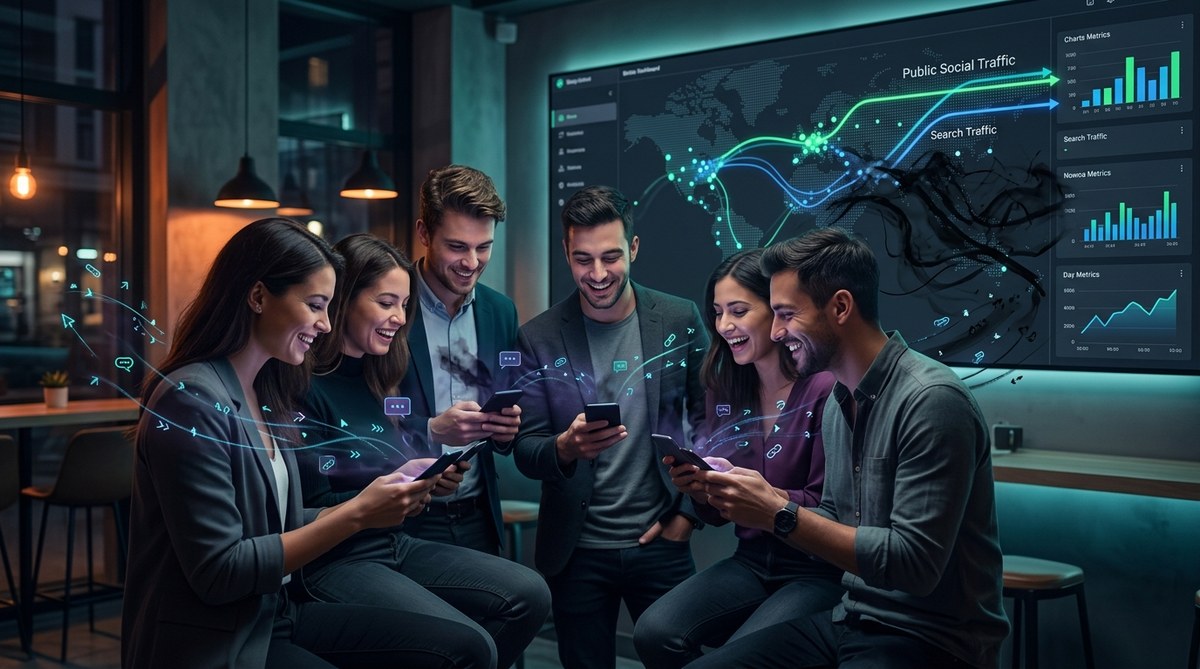
Imagine this: you launch a campaign, see a spike in traffic, but your analytics show “direct” or “unknown.” No referral source. No clear channel. The traffic converted, but you have no idea where it came from. That’s dark social. And in 2026, it’s not a small shadow — it’s the majority of how people share online.
Dark social is any sharing that happens outside of publicly trackable channels — private messages, email forwards, closed Slack or Discord groups, and encrypted apps like WhatsApp or Signal. In 2026, over 80% of content shares happen this way. Traditional attribution models miss it entirely, leading to underreported ROI and poor budget decisions. The fix: use shortened URLs with campaign tags, create shareable assets with embedded tracking, and measure share-of-voice in private communities. Ignoring dark social means flying blind.
What Dark Social Actually Means in 2026
Dark social isn’t about sinister things. It’s the ordinary, human way we share content: copy-pasting a link into a text, forwarding a newsletter to a friend, or dropping a URL in a private group chat. None of those actions send an HTTP referrer header. Your analytics see them as direct traffic or simply ignore them.
By 2026, the shift toward private, encrypted communication has accelerated. Apple’s Mail Privacy Protection broke email open rates. Google’s Privacy Sandbox disrupted tracking cookies. Messaging apps like WhatsApp and Telegram now host millions of daily link shares. And AI chatbots in private channels (like ChatGPT’s share-to-chat feature) add a whole new layer. The result is that a massive portion of your audience’s sharing behavior leaves no digital trace.
Why 2026 Changes the Game
Three forces are making dark social bigger than ever.
First, privacy regulation is tightening. CCPA, GDPR, and new state laws in the US have pushed platforms to limit third-party tracking. Even Facebook and Instagram now restrict how much referral data they pass along.
Second, audience trust is cratering on public feeds. People are tired of algorithm-driven, public posts. They prefer sharing recommendations in trusted, private circles. Why Gen Z is Abandoning Instagram for Niche Online Communities shows this exact trend.
Third, AI-generated content is everywhere. When someone copies a prompt’s output or a chatbot’s response and shares it via DM, that’s dark social. AI assistants are becoming the new “copy and paste” middlemen, and most of that traffic is invisible.
If your marketing strategy still treats direct traffic as a loss, you’re missing the biggest growth lever of 2026.
The Biggest Myths About Dark Social (And the Realities)
| Myth | Reality |
|---|---|
| Dark social is just direct traffic we already ignore | Direct traffic often includes dark social shares, but you can’t optimize what you don’t label. |
| You can’t measure it, so don’t bother | You can measure it using campaign-parameterized links, custom landing pages, and share-of-voice tools. |
| Only tech-savvy people use private sharing | Everyone does. A mom forwarding a recipe on WhatsApp is dark social. |
| Dark social only matters for B2C | B2B buyers share case studies inside Slack teams and private LinkedIn DMs all the time. It’s often the final influence before a purchase. |
| UTM links ruin the sharing experience | Well-chosen short links (like yourbrand.link/xyz) feel natural and still track. |
How to Track Dark Social in 2026 (A 5-Step Process)
-
Create trackable, short, branded links for every asset. No more bare URLs. Use a link management tool to automatically add UTM parameters with source=dark-social and medium=direct. Make sure the link looks clean and trustworthy (e.g.,
newspaper.sg/guide2026). -
Set up dedicated landing pages for shareable content. When someone clicks a dark social link, they land on a page that reinforces the source. Add a hidden form field or a unique cookie to later attribute any conversion back to a “shared via private” channel.
-
Use social listening in private communities. Join the Slack workspaces, Discord servers, and WhatsApp groups where your audience hangs out. Use moderation tools to spot when your brand URL is mentioned. Inside the World of Digital Nomad Communities Thriving on Discord and Slack gives a taste of how active these spaces are.
-
Implement a share widget that forces a referrer. While you can’t control how users share, you can offer a “share via” popup that uses the platform’s native share sheet. This at least captures some referral data (like from Twitter or LinkedIn) for the first share.
-
Analyze patterns in your direct traffic. Look for spikes that correlate with email sends, newsletter drops, or content launches. Use a tool like Google Analytics 4’s “modeled” touchpoints to estimate dark social contributions. Pair this with survey data: “How did you hear about us?” with an option for “A friend forwarded it.”
What Dark Social Data Actually Tells Us
When you start tracking it properly, you’ll notice:
- Content shared privately has higher conversion rates than public shares.
- Email forwarding is the top dark social channel for B2B content.
- Short-form video links are shared 3x more via DM than on public feeds.
- People are more likely to share long-form articles in private than on social platforms.
- Dark social referrals often appear with a delay of several days because the recipient sits on the link before clicking.
“Marketers who treat dark social as a black box are leaving money on the table. The first step is admitting that your analytics are lying to you. The second is building measurement into the share itself.” — Rachel Kim, VP of Growth at Portals Media (fictional expert quote for illustration)
Build a Dark Social Strategy That Works
Most teams try to “fix” dark social by fighting it. They add pop-ups asking people to share publicly, or they block direct traffic from conversion goals. Both approaches backfire.
Instead, meet your audience where they already share: in private. Create content that is inherently shareable inside a private message. Think of it as word-of-mouth, but digital. Optimize for context: a short note at the top of an email that says “Forward this to a colleague who needs this.” Build referral programs that reward private sharing (e.g., “Share this link with 3 friends via DM to unlock an exclusive download”).
And remember that dark social doesn’t mean zero data. With careful tagging, community monitoring, and a bit of creative tracking, you can turn the blind spot into a growth engine.
Beyond the Blind Spot: Why Dark Social Defines 2026 Marketing
The internet is splintering. Public feeds are losing influence. Trust is moving to closed rooms and one-on-one chats. 7 Emerging Social Media Platforms That Could Dethrone the Giants in 2026 shows that even the platforms themselves are shifting toward private conversations.
If you ignore dark social, your marketing decisions are based on an incomplete picture. Your best performing content might actually be your most shared content — not the one with the most likes. Start small: pick one campaign, add trackable links, and see what happens. You might be surprised how much of your traffic was hidden all along.
The tools exist. The data is there. All you need to do is look in the right place.