
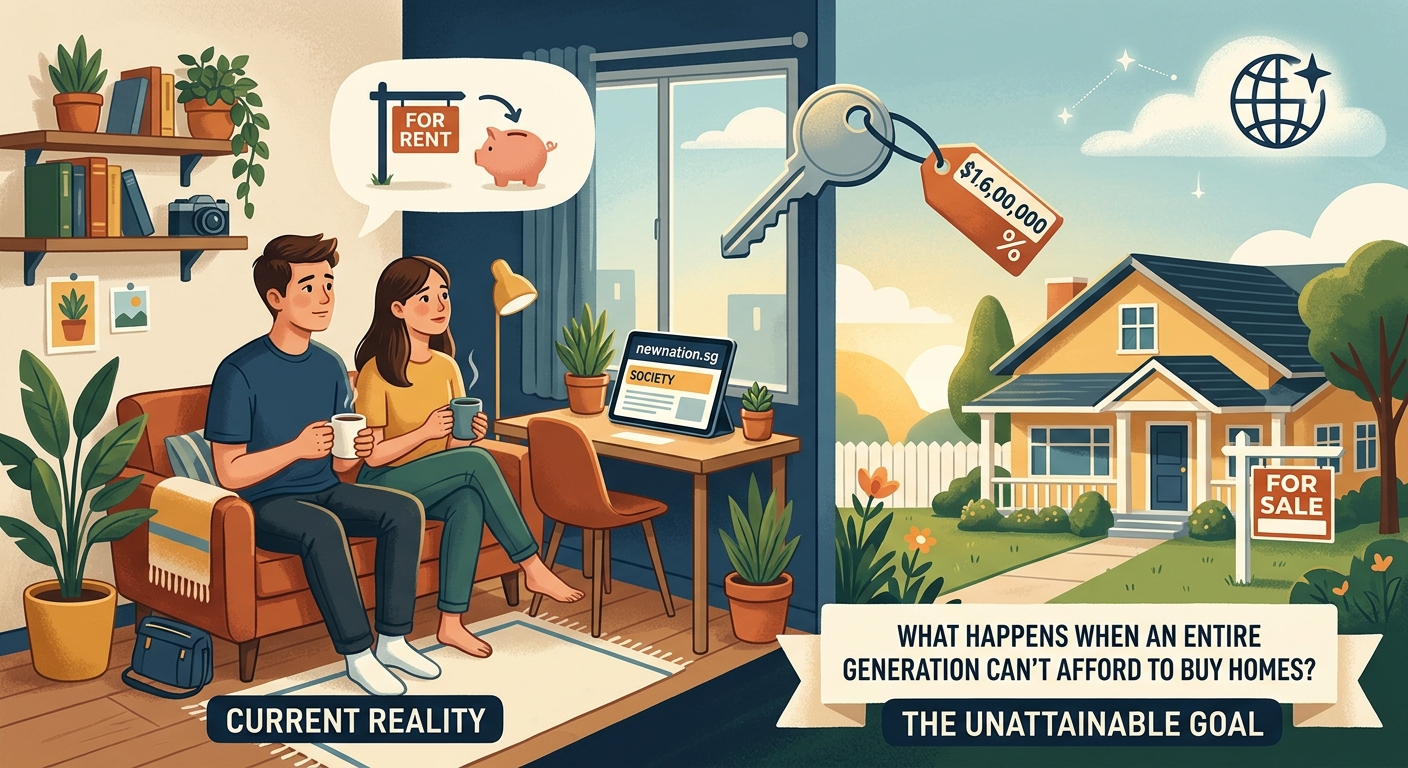
You’ve done everything right. College degree? Check. Stable job? Check. Savings account that isn’t laughable? Check. But when you look at home prices, the math simply doesn’t work. You’re not alone. Millions of millennials and Gen Z adults face the same brutal reality: homeownership feels like a distant fantasy reserved for trust fund kids and lottery winners.
When millennials can’t buy homes, the consequences ripple far beyond individual finances. [Wealth inequality](https://en.wikipedia.org/wiki/Wealth_inequality_in_the_United_States) widens as older generations accumulate assets while younger ones pay rising rents. Delayed family planning, reduced retirement savings, and weakened consumer spending reshape entire economies. Communities lose stability as renters move frequently, and the traditional path to middle-class security crumbles for millions.
The wealth gap becomes a wealth canyon
Homeownership has historically been the primary wealth-building tool for middle-class families. When that door slams shut for an entire generation, the consequences are staggering.
Baby boomers and Gen X homeowners watch their property values climb year after year. They build equity with every mortgage payment. They refinance at low rates. They borrow against their homes for renovations or emergencies.
Meanwhile, millennials write rent checks that vanish into someone else’s equity.
The numbers tell a harsh story. The median net worth of homeowners is roughly 40 times higher than renters. That gap isn’t just about the house itself. It’s about decades of compounding wealth that renters simply cannot access.
Your landlord benefits from your rent payments twice. First, you cover their mortgage. Second, their property appreciates while you build nothing. This creates a self-reinforcing cycle where the wealthy get wealthier and renters fall further behind.
Retirement becomes a pipe dream
Most financial advisors tell you to save 15% of your income for retirement. But when rent consumes 40% or 50% of your paycheck, that advice sounds like a cruel joke.
Homeowners enter retirement with a massive advantage. Their mortgage is paid off. Their housing costs drop to just property taxes, insurance, and maintenance. They can downsize and pocket the difference. They can reverse mortgage if needed.
Renters face a terrifying reality. They’ll pay rent forever. Even on a fixed income. Even when they’re 75 years old.
Social Security wasn’t designed to cover today’s rental prices. The average benefit barely covers a one-bedroom apartment in many cities. Without home equity to fall back on, millions of millennials face poverty in old age.
The retirement crisis isn’t coming. It’s already here. It just hasn’t fully materialized yet because millennials are still decades away from retirement age.
Family planning gets pushed back or abandoned
Homeownership and family planning have always been intertwined. People want space, stability, and good school districts before having kids.
When you can’t afford to buy, several things happen:
- You delay having children until it becomes medically risky or impossible
- You have fewer children than you wanted
- You raise kids in cramped apartments with no yard
- You move frequently, disrupting their education and friendships
- You sacrifice proximity to good schools because you can’t afford those neighborhoods
Birth rates are already dropping across developed nations. Housing affordability is a major factor. People aren’t choosing to have fewer kids because of changing values alone. They’re making hard financial calculations.
The societal implications are enormous. Fewer children mean fewer future workers, taxpayers, and consumers. Social safety nets that depend on large working populations start to crack.
Consumer spending contracts and economies suffer
Homeowners spend money differently than renters. They buy lawnmowers, furniture, appliances, and renovation materials. They invest in their properties. They feel confident making large purchases because they have equity to borrow against.
Renters live with constant uncertainty. Landlords can raise rent or refuse to renew leases. Moving is expensive and disruptive. This insecurity makes people cautious with money.
When an entire generation can’t buy homes, consumer spending patterns shift dramatically:
- Home improvement stores lose a massive customer base
- Furniture and appliance sales decline
- Local contractors and tradespeople have fewer clients
- Property tax revenues stagnate in some areas while skyrocketing in others
- Economic growth slows as household formation decreases
The economy depends on people feeling secure enough to spend. Permanent renters don’t feel secure. They hoard cash for the next rent increase or unexpected move.
Communities lose stability and cohesion
Homeowners stick around. They join neighborhood associations. They vote in local elections. They care about property values and local schools. They build relationships with neighbors over years or decades.
Renters move more frequently. The average renter moves every two years. That constant churn prevents community bonds from forming.
When neighborhoods shift from owner-occupied to renter-occupied, several changes occur:
- Voter turnout in local elections drops
- Participation in community organizations declines
- Long-term planning becomes difficult
- Property maintenance often decreases
- Social trust and neighborly connections weaken
These aren’t value judgments about renters versus owners. They’re natural consequences of different housing situations. When you know you might move next year, you invest less time and energy into your neighborhood.
The political landscape shifts
Housing affordability is already reshaping politics. Young voters increasingly support policies that would have been considered radical a generation ago.
Rent control. Massive public housing programs. Wealth taxes. Restrictions on corporate property ownership. These ideas gain traction when homeownership feels impossible through traditional means.
Political instability often follows when large segments of the population feel the system is rigged against them. When hard work and education no longer guarantee a path to homeownership, people question the entire economic structure.
History shows that societies with extreme wealth inequality and limited upward mobility eventually face upheaval. The form varies, but the pattern repeats.
The rental market becomes predatory
When people have no alternative to renting, landlords gain enormous power. Basic economics: when demand vastly exceeds supply and buyers can’t exit the market, prices rise and quality falls.
We’re already seeing this play out:
- Application fees that cost hundreds of dollars with no guarantee
- Bidding wars for rental units
- Landlords requiring income of 3x or 4x the monthly rent
- Security deposits that equal three months’ rent
- Junk fees for everything from package acceptance to trash removal
- Minimal maintenance and repairs because renters have limited recourse
Corporate landlords use algorithms to maximize rent increases. They coordinate pricing across properties. They lobby against renter protections.
When renting shifts from a temporary situation to a permanent state for millions, the power imbalance becomes exploitation.
Personal identity and self-worth take a hit
American culture has long equated homeownership with success and adulthood. Fair or not, that cultural programming runs deep.
When you can’t afford to buy despite doing everything “right,” it affects your sense of self. You feel like you’ve failed at a fundamental life milestone.
This psychological impact manifests in several ways:
- Shame about still renting in your 30s or 40s
- Reluctance to host gatherings in rental spaces
- Feeling stuck in adolescence despite professional success
- Resentment toward older generations who bought homes easily
- Anxiety about the future and your place in society
The mental health consequences are real. Financial stress is one of the leading causes of anxiety and depression. When that stress feels permanent and insurmountable, it takes a serious toll.
What the economic data actually shows
Let’s look at the numbers without sugar-coating them.
| Economic Indicator | Impact of Low Homeownership |
|---|---|
| Wealth accumulation | 80% lower for lifetime renters |
| Retirement savings | 60% less due to higher housing costs |
| Household formation | Delayed by 5-7 years on average |
| Birth rates | 15-20% lower in high-cost housing markets |
| Geographic mobility | Decreased as people can’t afford to move |
| Consumer spending | 12% lower on durable goods |
These aren’t hypothetical projections. They’re already happening in markets where homeownership has become unattainable for average earners.
The Federal Reserve data shows that millennials own significantly less wealth than previous generations did at the same age. Housing is the primary driver of this gap.
“We’re creating a two-tier society where homeowners accumulate wealth passively through appreciation while renters work harder just to stay in place. This isn’t sustainable economically or socially. When opportunity feels closed off, social cohesion breaks down.” — Economic Policy Institute research director
The cascade effect on related industries
Housing affordability doesn’t exist in a vacuum. When people can’t buy homes, the effects cascade through the economy.
Moving companies see less business. Mortgage lenders have fewer customers. Real estate agents handle fewer transactions. Home inspectors find less work. Title companies close fewer deals.
But it goes further. People who can’t buy homes often delay other major purchases:
- New cars (no garage or driveway)
- Expensive furniture (might move next year)
- Major appliances (landlord’s responsibility)
- Tools and equipment (no storage space)
- Home offices (no extra room)
The entire consumer economy is built on the assumption that people will eventually buy homes and fill them with stuff. When that assumption breaks down, economic models fail.
Geographic inequality intensifies
Affordable housing still exists. Just not where the jobs are.
You can buy a house in rural areas or declining Rust Belt cities. But good luck finding employment that pays enough to afford the mortgage.
The jobs concentrate in expensive coastal cities and tech hubs. Housing in those areas is impossibly expensive. This creates a brutal catch-22.
Young professionals face an impossible choice:
- Live where jobs are and rent forever
- Move somewhere affordable and struggle to find good employment
- Endure brutal commutes from distant suburbs
This geographic sorting has profound implications. Talent concentrates in expensive cities. Those cities become even more economically dominant. Other regions lose young, educated workers and struggle to compete.
The country becomes increasingly divided between thriving, unaffordable metros and affordable, declining regions.
Alternative paths emerge but with tradeoffs
Some millennials find workarounds. None are perfect.
Multigenerational living is making a comeback. Adult children live with parents longer or move back home. This works for some families but creates tension and limits independence.
House hacking becomes popular. Buy a duplex, live in one unit, rent the other. Great in theory, but you still need a down payment and qualify for a mortgage.
Tiny homes and van life appeal to some. They offer ownership at a lower price point but sacrifice space, stability, and often legal protection.
Moving to lower-cost countries as remote workers is another option. But it means leaving family, friends, and cultural connections behind.
Each alternative involves significant compromises. None replicate the stability and wealth-building potential of traditional homeownership.
When an entire generation rents forever
We’re running a massive social experiment with no historical precedent. Never before has an entire generation of middle-class workers been priced out of homeownership in a developed economy.
The closest comparison might be feudal systems where land ownership was restricted to nobility. That didn’t end well for social stability.
We don’t know exactly what happens when homeownership becomes a luxury good. But we can make educated guesses based on current trends.
Wealth inequality will reach levels not seen since the Gilded Age. Social mobility will grind to a halt. Political extremism will grow. Birth rates will continue falling. Retirement poverty will explode. Consumer spending will stagnate.
These aren’t doomsday predictions. They’re logical extensions of current trajectories.
The system wasn’t designed for this
Social Security, Medicare, and most retirement planning assume people will own homes by retirement. Those systems are already strained. They’ll break completely if millions of retirees still pay rent.
Tax policy favors homeowners. Mortgage interest deductions. Capital gains exclusions. Property tax deductions. Renters get none of these benefits.
Zoning laws and building codes were written when homeownership was the norm. They make dense, affordable housing difficult to build.
The entire economic and social infrastructure assumes widespread homeownership. When that assumption fails, the infrastructure fails too.
What comes next for a locked-out generation
The housing crisis isn’t resolving itself. Prices aren’t coming down. Wages aren’t rising fast enough. The gap keeps widening.
Something has to give. Either policy changes dramatically to make housing affordable again, or we accept a fundamental restructuring of society.
That restructuring means accepting that homeownership is a luxury, not a middle-class expectation. It means rethinking retirement security. It means redesigning communities for transient populations. It means confronting massive wealth inequality.
The alternative is policy intervention. Massive public housing programs. Strict limits on investor ownership. Zoning reform. Tax policy changes. None of these are politically easy, but they’re possible.
What isn’t sustainable is the current trajectory. You can’t have a stable society where working hard and playing by the rules leads to permanent renting and retirement poverty.
The consequences of locking millennials out of homeownership will define the next several decades. The ripple effects touch everything from birth rates to political stability to economic growth.
We’re already seeing the early stages. Lower marriage rates. Delayed childbearing. Rising political anger. Declining consumer confidence. These trends will accelerate unless something fundamental changes.
Your individual situation matters, but so does the bigger picture. Understanding these broader consequences helps explain why housing affordability isn’t just a personal finance issue. It’s a crisis that reshapes society in profound and lasting ways.