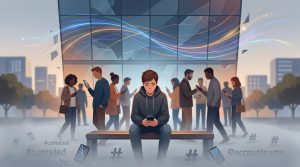
You scroll through your phone for the third time in ten minutes. Hundreds of contacts, dozens of group chats, endless feeds of people living their lives. Yet somehow, you feel completely alone.
This isn’t just you. It’s a paradox defining our generation: we’re more connected than ever, but loneliness rates have skyrocketed. The loneliness epidemic hyperconnectivity has created isn’t a coincidence. It’s a direct result of how we’ve replaced depth with breadth, presence with performance, and real connection with digital proximity.
The loneliness epidemic hyperconnectivity fuels stems from substituting meaningful relationships with superficial digital interactions. Despite having hundreds of online connections, people aged 25 to 45 report record isolation levels. Social media creates the illusion of connection while eroding the vulnerability and presence genuine relationships require. Breaking this cycle demands intentional choices about how we use technology and prioritize real human contact.
Why More Connections Mean Less Connection
The math doesn’t add up at first glance.
Previous generations had smaller social circles. They relied on phone calls, letters, and face-to-face meetings. Yet studies show they reported lower loneliness rates than we do today, despite our ability to message anyone, anywhere, anytime.
The difference lies in quality versus quantity.
Social media platforms encourage us to accumulate connections. We have Facebook friends we haven’t spoken to in years. LinkedIn contacts we’ve never met. Instagram followers we wouldn’t recognize on the street. Each platform gamifies connection, turning relationships into metrics: follower counts, like ratios, engagement rates.
But humans didn’t evolve for this kind of social structure.
Our brains developed to maintain around 150 meaningful relationships, a limit known as Dunbar’s number. When we spread our attention across 500 or 1,000 connections, each relationship becomes shallower. We know what everyone ate for lunch but not how they’re really doing.
This creates a strange cognitive dissonance. Your brain registers all these connections as social activity. You feel busy, engaged, constantly communicating. Yet none of these interactions satisfy your deep need for genuine intimacy and understanding.
The result? You can spend hours “being social” online and still feel profoundly lonely.
The Performance Trap
Social media transformed relationships into performances.
Every post becomes a curated highlight reel. You share the promotion, not the rejection that came first. The vacation photos, not the argument that happened an hour before. The smiling selfie, not the anxiety attack from that morning.
This performance culture creates two problems:
- You compare your messy reality to everyone else’s polished highlights
- You hide your struggles, preventing others from offering real support
- Vulnerability feels risky when everything is public and permanent
- Authentic connection requires honesty that platforms discourage
When everyone performs happiness, admitting loneliness feels like failure. You assume you’re the only one struggling while everyone else thrives. In reality, they’re scrolling through your posts thinking the same thing.
Research from the University of Pennsylvania found that limiting social media use to 30 minutes daily significantly reduced loneliness and depression. The study participants didn’t need to quit entirely. They just needed to stop substituting screen time for real interaction.
But breaking the performance habit takes conscious effort.
You have to risk being real in a space designed for perfection. You have to share struggles, not just successes. You have to ask for help instead of pretending you have it all together.
Most people can’t do this. The social cost feels too high. So they keep performing, keep scrolling, keep feeling isolated despite constant connectivity.
How Hyperconnectivity Rewires Your Brain
Your brain treats social media like junk food.
Each notification triggers a small dopamine hit. Likes, comments, messages, all activate the same reward circuits that evolved to reinforce genuine social bonding. But like empty calories, these digital interactions provide temporary satisfaction without real nourishment.
Over time, this rewires your reward system.
You start craving the easy dopamine hits from notifications instead of the deeper satisfaction from real conversation. Checking your phone becomes automatic. You reach for it during any moment of boredom or discomfort.
This creates a vicious cycle:
- You feel lonely or anxious
- You check social media for connection and distraction
- You get temporary relief from notifications and scrolling
- The underlying loneliness remains unaddressed
- You feel worse and repeat the cycle
Meanwhile, your capacity for real connection atrophies.
Face-to-face conversation requires sustained attention. You have to read body language, tone, facial expressions. You have to sit with uncomfortable silences. You have to be fully present without the option to scroll away.
These skills weaken with disuse.
People who spend more time on screens report more difficulty with in-person social situations. They feel awkward, anxious, out of practice. So they retreat further into digital communication, where interactions feel safer and more controlled.
The loneliness epidemic hyperconnectivity creates isn’t just about isolation. It’s about losing the very skills and capacities that enable genuine connection.
The Illusion of Availability
Your phone promises constant access to your entire social network.
In theory, you’re never alone. You can text a friend, post to your group chat, or scroll through familiar faces anytime. This creates an illusion of availability that actually increases isolation.
Because when connection feels infinitely available, you stop prioritizing it.
You think “I could text Sarah anytime” so you never actually do. You assume your friends are just a message away, so you don’t make concrete plans. The possibility of connection substitutes for actual connection.
This also changes how others relate to you.
When everyone assumes they can reach you anytime, no one feels urgency about maintaining the relationship. Plans become tentative. “Let’s hang out sometime” replaces actual calendar dates. Everyone stays in loose contact through occasional messages, but no one invests in deeper engagement.
Compare this to previous eras when connecting required real effort. You had to call someone’s landline and risk their parents answering. You had to make concrete plans because you couldn’t coordinate in real time. You had to show up because you couldn’t text “running late” from the car.
These constraints forced intentionality.
Relationships required active maintenance. You couldn’t coast on the illusion of availability. Either you made time for people or you drifted apart.
Now we exist in a strange middle ground: connected enough to feel like we’re maintaining relationships, but not connected enough to feel truly known or supported.
What Real Connection Actually Requires
Genuine relationships need three elements that hyperconnectivity undermines: presence, vulnerability, and consistency.
Presence means giving someone your full attention. Not scrolling while they talk. Not mentally composing your response while they’re still speaking. Not checking notifications every few minutes. Just being there, fully engaged with another human.
This has become remarkably difficult.
Studies show most people check their phones every 12 minutes on average. Even when you’re not actively using it, knowing your phone is nearby reduces your cognitive capacity and attention quality. Your brain allocates resources to monitoring for notifications, leaving less for the person in front of you.
Vulnerability means letting people see your real struggles, fears, and imperfections. Not the curated version you post online. Not the “I’m fine” you offer when you’re not. The messy, complicated truth of being human.
Social media actively discourages this.
Everything you post becomes permanent, searchable, potentially shareable. Admitting weakness or struggle can feel like handing ammunition to critics or competitors. So you keep up the performance, even with people you consider friends.
Consistency means showing up repeatedly over time. Relationships deepen through accumulated shared experiences, inside jokes, weathering difficulties together. You can’t build this through occasional likes or birthday messages.
“Loneliness isn’t about being alone. It’s about feeling unseen. You can be surrounded by people, even constantly messaging them, and still feel like no one really knows you. Real connection requires letting yourself be known, which means being present and honest over time, not just maintaining digital contact.” – Dr. Vivek Murthy, former U.S. Surgeon General
Breaking the Cycle
Addressing the loneliness epidemic hyperconnectivity creates requires intentional changes to how you use technology and structure your social life.
Here’s a practical framework:
| Strategy | What It Looks Like | Common Mistake |
|---|---|---|
| Digital boundaries | Designated phone-free times and spaces | Checking “just for a second” |
| Quality over quantity | Fewer, deeper relationships | Trying to maintain all connections equally |
| Scheduled connection | Recurring plans with specific people | Vague “we should hang out” intentions |
| Vulnerable sharing | Admitting struggles to trusted friends | Only sharing highlights and successes |
| Present attention | Full focus during conversations | Multitasking or monitoring notifications |
| In-person priority | Choosing face-to-face over digital when possible | Defaulting to text for convenience |
Start with these specific actions:
-
Identify your core people. List 5 to 10 relationships you want to prioritize. These are people you want to genuinely know and be known by, not just stay vaguely connected to.
-
Create recurring touchpoints. Schedule regular contact with each person. Weekly coffee, monthly dinners, whatever fits your lives. Put it on the calendar like any other commitment.
-
Establish phone-free zones. Designate times and places where devices don’t belong. Meals, bedrooms, first hour after work. Start small but be consistent.
-
Practice vulnerable sharing. Next time someone asks how you’re doing, try answering honestly. Share a real struggle, not just “fine” or “busy.” Notice how it changes the conversation.
-
Choose presence over documentation. At your next social event, keep your phone in your pocket. Experience the moment instead of capturing it for later posting.
These changes feel awkward at first.
You’ll reach for your phone out of habit. You’ll feel exposed when you share honestly. You’ll worry you’re being demanding by asking for scheduled time together.
Push through the discomfort.
Real connection always requires some risk. You have to be willing to need people, to show up imperfectly, to invest time and attention without guaranteed returns.
The Social Architecture Problem
Individual changes help, but the loneliness epidemic hyperconnectivity drives also reflects larger structural issues.
Modern life is designed for isolation.
We work remotely or in offices where everyone wears headphones. We live in apartments where we don’t know our neighbors. We order everything online to avoid stores. We stream entertainment alone instead of gathering in shared spaces.
Previous generations had built-in social infrastructure.
Churches, civic organizations, neighborhood associations, union halls. These weren’t perfect, but they created regular opportunities for face-to-face interaction across different contexts. You saw the same people repeatedly, building relationships through proximity and consistency.
Most of these structures have weakened or disappeared.
Religious attendance has dropped. Civic participation has declined. People move more frequently, preventing deep neighborhood roots. The “third places” between home and work, like cafes, parks, and community centers, have become rarer or more commercialized.
Technology was supposed to fill this gap.
Instead, it accelerated the trend. Why go to a community meeting when you can join an online group? Why visit a cafe when you can video chat from home? Why attend a class when you can watch tutorials alone?
Each individual choice makes sense. But collectively, they’ve created an environment where loneliness becomes the default.
Addressing this requires more than personal discipline. We need to rebuild social infrastructure that brings people together in real space, with real consistency, around shared interests or purposes.
Some communities are trying:
- Co-working spaces that host social events
- Neighborhood tool libraries that encourage interaction
- Community gardens with shared maintenance
- Adult sports leagues focused on fun over competition
- Volunteer organizations that create regular commitments
These initiatives recognize that connection can’t be left to chance or individual effort. We need structures that make it easy and natural to encounter the same people repeatedly, building relationships through accumulated interaction.
When Digital Connection Works
Not all online interaction deepens isolation.
Some digital tools genuinely support connection when used intentionally. The difference lies in whether technology supplements real relationships or substitutes for them.
Video calls with distant family members maintain bonds that geography would otherwise strain. Group chats help friend groups stay coordinated and share daily life. Online communities connect people with rare interests or experiences who might never meet otherwise.
These uses work because they serve connection rather than replacing it.
The problem isn’t technology itself. It’s when we use digital interaction as our primary or only form of connection. When we substitute scrolling for conversation. When we perform for audiences instead of being real with individuals. When we collect connections instead of deepening relationships.
The goal isn’t to abandon technology. It’s to use it as a tool for connection rather than a replacement for it.
This means being honest about what different platforms provide.
Social media can help you stay aware of people’s lives, but it can’t replace actual conversation. Texting can coordinate plans, but it can’t replace being together. Online communities can provide support and information, but they work best alongside local, in-person relationships.
When you’re clear about what each tool can and can’t do, you can use them effectively without falling into the trap of mistaking digital activity for genuine connection.
Rebuilding Your Social World
Addressing your own loneliness while living in a hyperconnected world requires treating it like any other important project.
You need intention, systems, and consistency.
Start by auditing your current situation honestly. How many people could you call right now with a real problem? How many know what you’re actually struggling with? How many have you seen in person in the last month? How many interactions left you feeling energized versus drained?
These questions reveal the gap between your network size and your actual support system.
Then make concrete choices about where to invest your limited time and energy.
You can’t maintain deep relationships with everyone. You have to choose. This feels uncomfortable because it means accepting that some connections will fade. But trying to maintain surface-level contact with everyone guarantees you’ll lack depth with anyone.
Focus on reciprocal relationships.
Notice who reaches out, who shows up, who asks real questions and listens to answers. Invest there. Let go of connections that only flow one direction or exist purely online.
Create regular rhythms of connection.
Standing weekly plans work better than sporadic hangouts. Consistency builds depth. Even 30 minutes of focused conversation each week creates more connection than occasional three-hour catch-ups every few months.
Practice being the friend you wish you had.
Reach out first. Ask specific questions. Share honestly. Show up for people. Make concrete plans. Follow through. Be present.
Most people wait for others to initiate, then feel lonely when no one does. Someone has to go first. It might as well be you.
Finding Your Way Back to Real Connection
The loneliness epidemic hyperconnectivity creates isn’t inevitable or permanent.
You can feel genuinely connected again. But it requires swimming against the current of how modern life is structured. It means choosing presence over productivity, depth over breadth, vulnerability over performance.
Start small. Pick one person you want to connect with more deeply. Reach out today. Make a concrete plan. Show up fully when you’re together. Share something real.
Then do it again next week.
Real connection is built through accumulated moments of presence, honesty, and consistency. You can’t shortcut it with technology or efficiency hacks. You have to invest the time, take the risks, and do the uncomfortable work of being genuinely known.
But the alternative is staying trapped in the paradox: surrounded by connections yet feeling profoundly alone.
Your brain knows the difference between scrolling and belonging. Your body knows the difference between notifications and being truly seen. You can’t trick yourself into feeling connected by accumulating digital interactions.
The path forward is surprisingly simple, even if it’s not easy. Put down your phone. Look people in the eye. Ask real questions. Share honest answers. Show up repeatedly. Let yourself be known.
That’s how you build a life where you’re not just connected, but where you actually belong.