
The 40-year career at a single company is dead. Gen Z knows it, and they’re not pretending otherwise.
Instead of climbing a corporate ladder, they’re building portfolio careers. They’re freelancing, side hustling, and stitching together income streams that would make their parents nervous. This isn’t rebellion for rebellion’s sake. It’s a calculated response to economic realities, technological opportunities, and a fundamentally different view of what work should be.
Gen Z is abandoning traditional career paths because they’ve witnessed job insecurity, value flexibility over stability, and have access to digital platforms that enable multiple income streams. They prioritize purpose, autonomy, and work-life balance over the promise of long-term corporate employment. This shift is reshaping hiring practices, workplace culture, and how we define career success in the modern economy.
The traditional career promise broke before Gen Z entered the workforce
Gen Z watched millennials do everything “right” and still struggle. They saw college graduates with debt working retail jobs. They witnessed parents lose pensions after decades of loyalty. The 2008 financial crisis happened during their childhood, and the pandemic disrupted their entry into the workforce.
The social contract that promised stability in exchange for loyalty simply doesn’t exist anymore. Companies restructure, automate, and outsource without hesitation. Why commit to an employer that won’t commit to you?
This generation entered adulthood understanding that job security is a myth. They’re not being cynical. They’re being realistic.
Traditional career paths also demand geographic inflexibility. You go where the job is. You relocate for promotions. You sacrifice personal preferences for professional advancement.
Gen Z isn’t interested in that trade. They want to live where they want to live and build work around that choice, not the other way around.
Economic realities make diversification a survival strategy
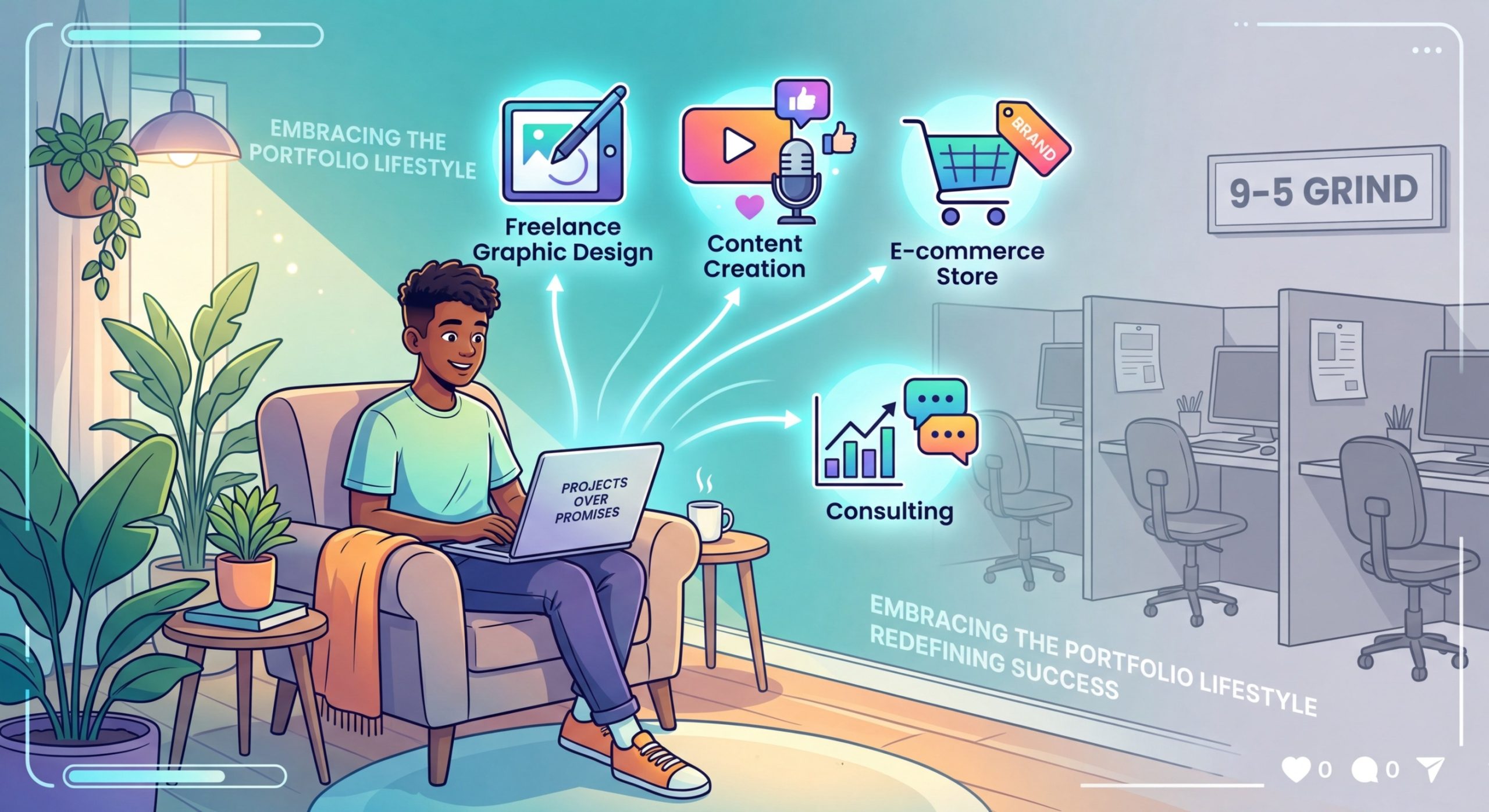
Relying on a single income source feels risky to Gen Z, not safe. They’ve seen entire industries collapse overnight. They understand that having multiple revenue streams is actually more secure than putting all your eggs in one corporate basket.
The gig economy makes this possible in ways it never was before. You can drive for a rideshare service, freelance your design skills, rent out a spare room, and consult on the side. Each income stream is small, but together they create resilience.
Here’s what a typical Gen Z portfolio career might include:
- Primary freelance work in their core skill area
- Passive income from digital products or content creation
- Part-time consulting or contract work
- Side projects that might scale into businesses
- Platform-based gig work for flexible income
This approach also addresses wage stagnation. Entry-level salaries haven’t kept pace with cost of living. Building multiple income streams lets Gen Z workers increase earnings without waiting for annual raises that barely cover inflation.
Technology enables what previous generations couldn’t access
Previous generations needed institutional gatekeepers. You needed a company to provide health insurance, retirement benefits, and professional infrastructure.
Gen Z can access all of this independently. Freelance platforms connect them with clients globally. Digital tools let them run entire businesses from laptops. Online communities provide professional networks without corporate affiliation.
The barrier to entry for entrepreneurship has collapsed. You don’t need venture capital to start. You need a skill, an internet connection, and the willingness to learn as you go.
Social media also changed the game. Gen Z workers can build personal brands that transcend any single employer. Their reputation and network belong to them, not to a company email address that disappears when they leave.
This technological infrastructure makes portfolio careers practical, not just aspirational.
Values shifted from climbing ladders to designing lifestyles
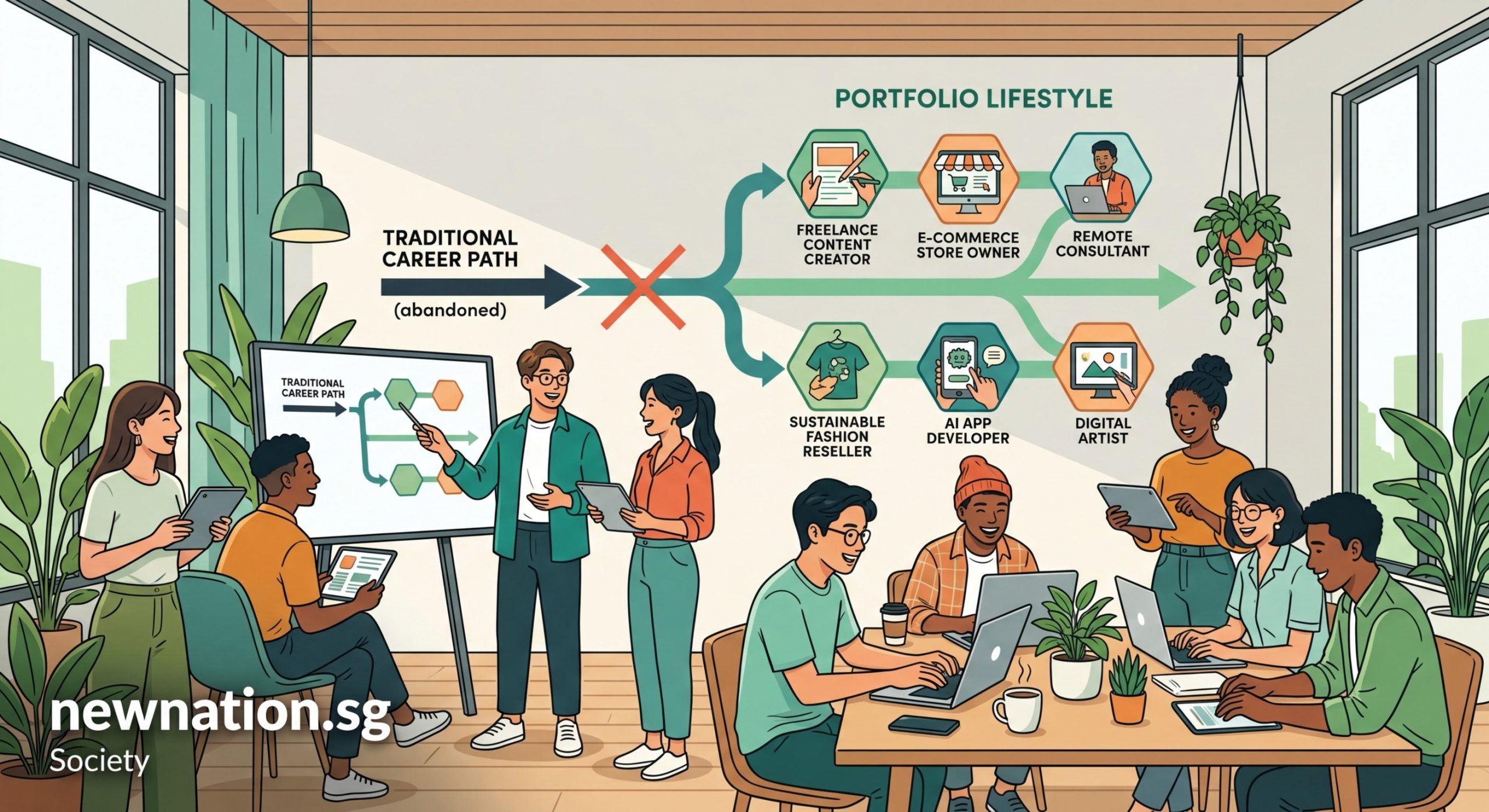
Gen Z prioritizes different things than previous generations. They value experiences over possessions. They want work that aligns with personal values. They refuse to sacrifice mental health for career advancement.
Traditional career paths often conflict with these priorities. Corporate culture frequently demands face time over results, values presenteeism over productivity, and measures success by hours logged rather than impact created.
Portfolio careers let Gen Z design work around their lives instead of designing lives around work. They can take a month off to travel without asking permission. They can work intensely for three months, then scale back. They control the rhythm.
This isn’t laziness. It’s intentionality about how they spend their finite time on earth.
“We’re not anti-work. We’re anti-wasting our lives doing work that doesn’t matter to us. If that means cobbling together five different projects instead of one corporate job, that’s a trade we’re willing to make.”
The rise of purpose-driven work over prestige-driven careers
Gen Z cares less about impressive job titles and more about meaningful work. They’d rather contribute to something they believe in than climb a hierarchy at a company whose mission leaves them cold.
Traditional career paths often separate purpose from paycheck. You do your job to earn money, then pursue meaning in your personal time. Gen Z rejects that division.
Portfolio careers allow them to align income with impact. They can choose clients and projects that reflect their values. They can say no to work that feels ethically compromising. They have agency that traditional employment rarely provides.
This also explains why so many Gen Z workers are drawn to creator economies, social enterprises, and mission-driven startups rather than established corporations.
Comparing traditional paths with portfolio approaches
| Aspect | Traditional Career | Portfolio Career |
|---|---|---|
| Income source | Single employer | Multiple streams |
| Security model | Job stability | Income diversification |
| Skill development | Company-directed training | Self-directed learning |
| Geographic flexibility | Limited by job location | Work from anywhere |
| Schedule control | Fixed hours, vacation approval | Self-managed time |
| Career progression | Vertical ladder climbing | Horizontal skill building |
| Risk profile | Company-dependent | Self-dependent |
| Benefits | Employer-provided | Self-sourced |
What employers get wrong about Gen Z workers
Many companies misread Gen Z’s career choices as disloyalty or lack of ambition. They’re missing the point entirely.
Gen Z will commit deeply to work they find meaningful. They’ll put in extraordinary effort for projects they believe in. But they won’t pretend to be grateful for jobs that undervalue them or cultures that drain them.
They’re also not afraid of hard work. Building a portfolio career is significantly harder than showing up to a single job. It requires entrepreneurial thinking, financial management, constant skill development, and high tolerance for uncertainty.
What looks like job hopping is often strategic skill acquisition. Gen Z workers might spend a year at a company specifically to learn a particular skill or technology, then move on. They’re building a resume of capabilities, not tenure.
How to build a portfolio career in practical steps
For those considering this path, here’s a realistic approach:
-
Start while you still have stable income. Don’t quit your job and hope for the best. Build your first alternative income stream while employed.
-
Identify your transferable skills. What can you do that people will pay for? Focus on skills with market demand, not just personal interest.
-
Test different income streams small. Try freelancing on weekends. Launch a small digital product. See what gains traction before going all in.
-
Build financial reserves. Portfolio careers have variable income. You need savings to smooth out the gaps between projects.
-
Create systems for the business side. Set up invoicing, contracts, accounting, and client management early. Don’t wait until you’re overwhelmed.
-
Network relentlessly. Your professional relationships become even more critical when you don’t have a company providing leads.
-
Develop a personal brand. Your reputation is your resume. Invest in making yourself visible and credible in your field.
The challenges nobody mentions about portfolio work
This path isn’t all freedom and flexibility. It comes with real downsides that deserve honest discussion.
Income instability creates stress. Some months are feast, others are famine. You need strong financial discipline and comfort with uncertainty.
You’re responsible for everything. There’s no HR department, no IT support, no accounting team. Every business function falls on you until you can afford to outsource.
Isolation can be intense. Traditional jobs provide built-in social interaction. Portfolio workers need to actively create professional community and social connection.
Benefits are expensive. Health insurance, retirement contributions, and other perks that employers subsidize come entirely out of your pocket.
The work never fully stops. When you control your schedule, the boundaries between work and life blur. You need discipline to protect personal time.
What this means for the future of work
Gen Z’s career choices are already reshaping workplace expectations. Companies are being forced to offer more flexibility, clearer purpose, and better work-life integration.
We’re seeing the rise of project-based hiring, contract work normalized at senior levels, and companies building talent networks rather than permanent headcount.
This shift also challenges how we structure social benefits. When fewer people have traditional employment, we need new systems for healthcare, retirement, and economic security.
Educational institutions are slowly adapting too. More programs focus on entrepreneurial skills, portfolio building, and self-directed career management rather than preparing students for corporate tracks.
Making sense of the new career landscape
Gen Z isn’t ditching traditional career paths because they’re lazy or entitled. They’re responding rationally to the world they inherited.
They’ve watched the old playbook fail. They have tools previous generations didn’t. They value different outcomes than their parents did.
Whether you’re a Gen Z worker considering this path, an employer trying to attract talent, or someone from another generation trying to understand the shift, the key is recognizing that this isn’t a phase. This is a fundamental restructuring of how we think about work, career, and the relationship between employment and identity.
The question isn’t whether traditional career paths will survive. It’s how quickly institutions will adapt to a workforce that’s already moved on.