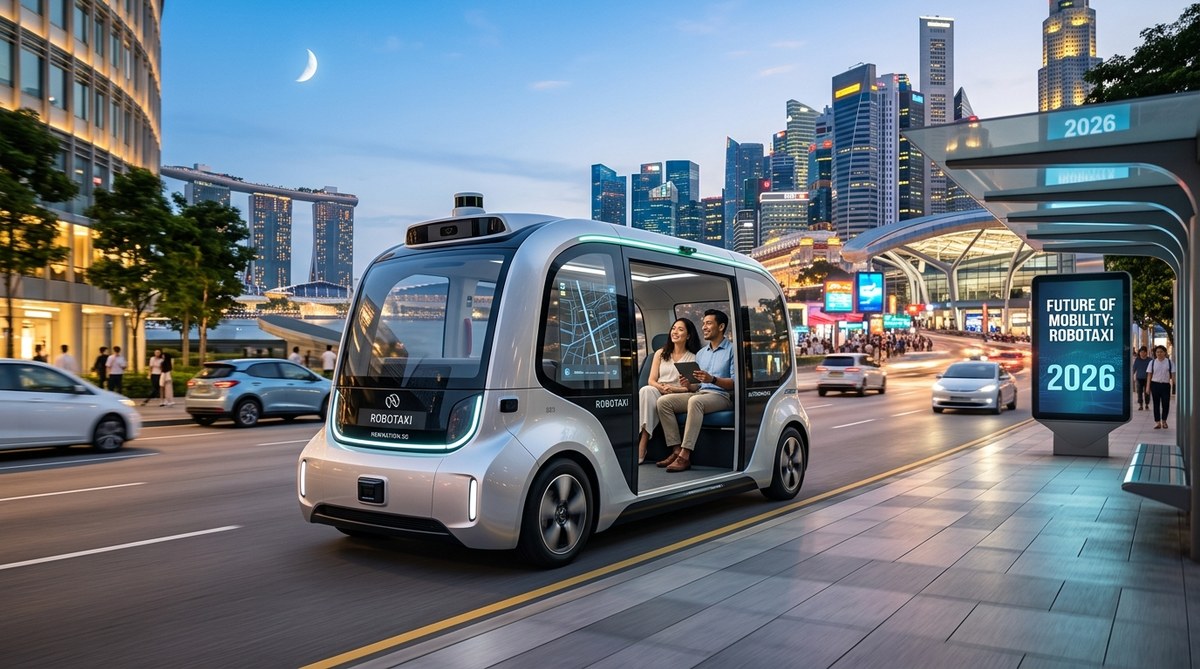
For years, the promise of a car that picks you up with no one behind the wheel felt like a futuristic fantasy reserved for sci-fi movies. But 2026 is shaping up differently. Across the US, autonomous ride-hailing services are no longer just testing in empty parking lots. They are picking up real passengers, charging real fares, and expanding into major cities. The question is: Is 2026 the year the robotaxi finally goes mainstream? Or are we still a few years away from ditching the steering wheel for good?
2026 marks a turning point where robotaxis move from pilot programs to real commercial operations in multiple US cities. Waymo, Cruise, and Tesla are all racing to expand. But full nationwide availability is still years away. Early adopters in select metros can ride today, but expect limited zones, cautious speeds, and the occasional need to take over. The technology is real, but the rollout will be gradual.
The State of Robotaxis Heading into 2026
Right now, if you live in Phoenix, San Francisco, or parts of Los Angeles, you can already open an app and hail a driverless taxi. Waymo has been running a paid service in those areas for over a year. Cruise, after a brief suspension in late 2023, is back on the streets in a handful of cities with a focus on safety and transparency. Tesla has promised a dedicated robotaxi network that could launch as early as late 2026, though skeptics point to the gap between Musk’s timelines and reality.
The big shift this year is scale. Companies are no longer just testing. They are applying for permits in Austin, Miami, and Washington D.C. They are partnering with local governments to map city streets at high resolution. And they are lowering costs to compete with Uber and Lyft.
Why 2026 Could Be a Breakthrough Year
Several factors align:
- Regulatory progress. The National Highway Traffic Safety Administration (NHTSA) has updated guidelines to allow more autonomous vehicle deployments without requiring special exemptions. States like California, Nevada, and Texas have streamlined approval processes.
- Cost reductions. The sensors and computing power inside a robotaxi have dropped dramatically in price. Lidar units that cost $75,000 five years ago now cost under $5,000. That makes deploying a fleet much cheaper.
- Public acceptance. Surveys show that after a few years of cautious media coverage, more people are willing to try a driverless ride. The novelty is wearing off, and the convenience is gaining traction.
- Safety track record. Despite high-profile accidents, the overall crash rate for autonomous vehicles (when factoring in miles driven) is lower than human-driven vehicles for the types of conditions they operate in.
“Robotaxis are not perfect, but the data shows they already cause fewer injuries per mile than the average Uber driver. The biggest challenge isn’t the tech anymore, it’s the edge cases: construction zones, bad weather, and unpredictable pedestrians.” Dr. Elena Torres, autonomous vehicle safety analyst
The Map of Robotaxi Rollouts in 2026
Not all robotaxis are created equal. The table below gives you a snapshot of what each major player is doing in 2026.
| Company | Active Cities (2026) | Key Milestone | Notes |
|---|---|---|---|
| Waymo | Phoenix, SF, LA, Austin, Miami | Fully driverless paid service in all cities | Most mature fleet, 24/7 service in selected zones |
| Cruise | San Francisco, Dallas, Houston | Resumed limited service after 2023 suspension | Operating only in good weather and daylight for now |
| Tesla | Promised “dozens of cities” by end of 2026 | Still testing with human safety drivers publicly | No fully driverless service confirmed yet |
| Zoox | Las Vegas, San Francisco | Custom-built robotaxis with no steering wheel | Only available to invited testers, not public |
| Amazon’s Zoox | San Francisco, Las Vegas | Commercial launch planned for mid-2026 | Similar to Waymo but with a smaller fleet |
What this table tells us: if you live in a major Sun Belt city or the Bay Area, you probably have a real option. If you live in the Midwest or Northeast, you are likely waiting until 2027 or 2028.
What You Need to Know Before Your First Ride
Taking a robotaxi is not exactly like calling an Uber. Here is a step-by-step guide to what you can expect.
- Download the right app. Each company has its own app. Waymo is called Waymo One. Cruise has its own app. Tesla’s network (if it launches) will be integrated into the Tesla app.
- Check the service area. Most robotaxis only operate within a geofenced zone. You cannot take one from downtown to the airport if the airport is outside the zone. Look at the map in the app before you set your pickup location.
- Pay attention to the vehicle. When the car arrives, it will look like a normal car but with a bunch of sensors on the roof. Enter as you normally would. There is a screen inside that shows the route and may display a “Start Ride” button. Tap it.
- Keep your hands off the wheel. If there is a steering wheel, you are not supposed to touch it unless an emergency intervention is needed. The car will tell you if it needs you to take over.
- Know what to do in a problem. If the car gets stuck or you feel unsafe, there is usually a “Pull Over” button or a help line. Use it. Do not open the door while the vehicle is moving.
What to Expect During the Ride
- You will see cameras and sensors everywhere. It’s normal.
- The car drives smoothly but conservatively. It may brake early for pedestrians.
- No music or climate control adjustments unless the app offers them.
- The fare is often cheaper than traditional rideshare, but prices vary by city and time.
The Hurdles Still Ahead
Even with all the progress, 2026 is not the year everyone gives up their personal car. Here are the biggest obstacles.
- Weather. Heavy rain, snow, and fog still confuse sensors. Most robotaxis avoid operating in bad weather.
- Unpredictable scenarios. Construction zones, parades, and emergency vehicles can freeze the car’s decision making.
- Trust. Many people still feel uneasy about a car with no driver. One scary incident can set public perception back months.
- Infrastructure. Some cities lack the digital maps and 5G connectivity needed for reliable operation.
A recent report from the RAND Corporation found that robotaxis need to drive billions of miles to statistically prove they are safer than human drivers. We are not there yet. But we are getting closer every month.
How to Prepare for the Robotaxi Era
If you want to be an early adopter, here is what you can do right now.
- Check if your city is on the expansion list for 2026. Waymo and Cruise publish their planned zones.
- Make sure your phone is compatible with the robotaxi apps. Older phones may not handle the mapping software well.
- Read your local regulations. Some states require you to sign a waiver before riding.
- Consider how robotaxis might change your commute. If you live in a zone, you might save money on parking and gas.
For tech enthusiasts and investors, the implications are huge. Robotaxis could disrupt everything from car insurance to public transit. They could reshape real estate, as people move further from city centers if they can work during the commute. The rise of digital nomad culture might even get a boost as long-distance travel becomes more automated.
Your Next Ride Might Not Have a Steering Wheel
It is easy to get cynical about self-driving cars. We have been hearing “next year” for a decade. But 2026 feels different. The vehicles are on the road. The regulatory barriers are falling. The public is warming up.
Still, this is not a sudden revolution. It is a gradual expansion, city by city, block by block. By the end of 2026, if you live in a top ten US metro, you will likely have the option to take a robotaxi. It might not be everywhere, or run 24/7, or handle a snowstorm. But it will be real. And that is a huge step.
So if you get the chance, take a ride. Experience it. Then decide how you feel. The technology is here. The question is how quickly we choose to let it drive.