
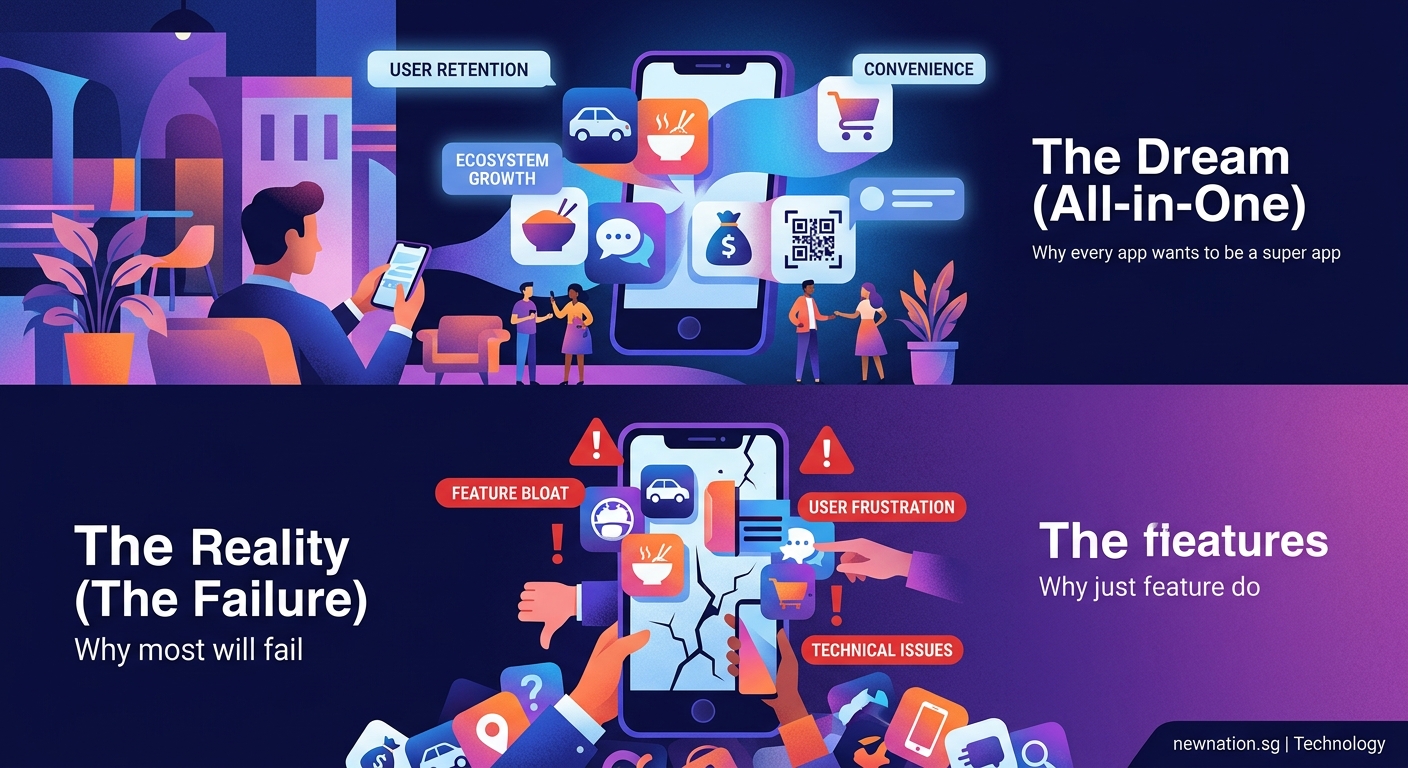
Super apps promise everything. One platform for messaging, payments, food delivery, ride hailing, shopping, and more. WeChat proved it could work in China. Grab and Gojek showed Southeast Asia was ready. Now every tech company wants a piece of the action.
The problem? Most will crash and burn.
Super apps fail because companies misjudge market conditions, overestimate their core product strength, and underestimate the operational complexity of managing multiple services. Success requires dominant market position, strong network effects, favorable regulations, and cultural acceptance of consolidated platforms. Without these foundations, super app strategies drain resources while confusing users and diluting brand identity.
The super app graveyard is getting crowded
Uber tried to become a super app. They added food delivery, grocery shopping, package delivery, and even pet transportation. The result? A bloated interface that confused riders and drivers alike.
Facebook attempted the same with Messenger. They crammed in games, payments, shopping, and business tools. Users revolted. The app became slower, harder to use, and less focused on its core purpose.
Snapchat added everything from news to shopping to gaming. Their stock price tanked as users fled to simpler alternatives.
These aren’t small players. These are tech giants with billions in funding, millions of users, and teams of brilliant engineers. Yet they still failed.
Why geography determines super app survival

Super apps thrive in specific conditions. China, Southeast Asia, and parts of Latin America created the perfect environment. These regions share common traits that make super apps viable.
First, smartphone adoption jumped ahead of traditional banking infrastructure. Millions of people got their first internet connection through a phone, not a computer. They never had credit cards or bank accounts. A super app that handled payments, commerce, and communication filled a genuine void.
Second, regulatory environments were either supportive or simply absent. Governments didn’t have established rules for digital payments or ride hailing. Companies could move fast and build ecosystems before regulators caught up.
Third, income levels made convenience more valuable than specialization. When you’re earning $500 a month, downloading ten different apps and managing ten different accounts feels wasteful. One app that does everything makes economic sense.
Western markets don’t share these conditions. Most Americans and Europeans already have bank accounts, credit cards, specialized apps, and strong consumer protection laws. The pain point a super app solves simply doesn’t exist.
The network effect trap
Companies assume their existing user base will automatically adopt new features. This is the first fatal mistake.
You built a successful ride hailing app. You have 10 million users who trust you to get them home safely. Now you add food delivery. Seems logical, right? Same drivers, same infrastructure, same customers.
Except your customers don’t see it that way. They downloaded your app to solve one problem: getting rides. When they want food, they already have a preferred app. That app knows their address, their dietary restrictions, their favorite restaurants. Switching requires effort for zero benefit.
Your drivers face the same friction. They optimized their process for passenger transport. Food delivery requires different routes, different timing, different customer interactions. Many will ignore the feature entirely.
Network effects don’t transfer automatically between services. Each new feature starts from zero and must prove its value independently.
The resource allocation nightmare
Building a super app means competing in multiple markets simultaneously. Each market has established leaders with years of experience and optimized operations.
| Challenge | Impact on Resources | Common Outcome |
|---|---|---|
| Multiple product teams | Engineering resources spread thin | Slower development across all features |
| Competing priorities | Leadership attention divided | Strategic drift and missed opportunities |
| Different operational needs | Support and logistics complexity | Higher costs, lower quality |
| Brand confusion | Marketing message diluted | Weaker position in every category |
Your payments team needs to compete with PayPal and Stripe. Your food delivery team faces DoorDash and Uber Eats. Your messaging team battles WhatsApp and Telegram. Your e-commerce team fights Amazon and Shopify.
Each competitor focuses 100% of their resources on their category. You’re splitting attention across five or ten different battles. You can’t win them all. You probably can’t win any of them.
User experience breaks down fast
Every new feature adds complexity. Complexity kills user experience.
Consider the navigation problem. A ride hailing app needs three main screens: request ride, track ride, payment history. Simple. Clean. Anyone can figure it out in seconds.
Add food delivery and you need restaurant browsing, menu navigation, order tracking, and review systems. Add payments and you need transaction history, linked accounts, security settings, and merchant tools. Add shopping and you need product catalogs, shopping carts, and return management.
Now your home screen has seven tabs instead of two. Your settings menu has forty options instead of eight. Your notification system sends alerts for rides, food orders, payment confirmations, shipping updates, and promotional offers.
Users came to your app for simplicity. You gave them complexity. They leave.
The brand identity crisis
Strong brands stand for something specific. Super apps try to stand for everything. This creates a fundamental problem.
Spotify means music streaming. When you see their logo, you know exactly what you’re getting. If Spotify suddenly offered tax preparation services, you’d be confused. The brand promise and the service offering wouldn’t match.
The same applies to every successful app. Instagram means photo sharing. Venmo means peer payments. Airbnb means short-term rentals. The brand and the service are inseparable.
When you transform a focused brand into a super app, you break that connection. Users don’t know what you stand for anymore. New users don’t understand what problem you solve. Marketing becomes impossible because you can’t craft a clear message.
The strongest brands own a single word in the customer’s mind. When you try to own ten words, you end up owning none.
Seven reasons super app strategies collapse
Let’s get specific about where things go wrong:
-
Misreading market maturity: Launching a super app in a market where specialized apps already dominate each category means fighting uphill battles everywhere simultaneously.
-
Underestimating regulatory complexity: Each service category brings its own regulatory requirements. Payments need banking licenses. Food delivery needs health permits. Transportation needs vehicle regulations. Managing compliance across multiple domains overwhelms most legal teams.
-
Overestimating core product strength: Success in one category doesn’t guarantee success in others. Your ride hailing expertise tells you nothing about restaurant logistics or retail inventory management.
-
Ignoring unit economics: Each new service needs to be profitable independently. Cross-subsidizing unprofitable features with revenue from your core business works until it doesn’t. Eventually, investors or boards demand profitability across the board.
-
Underestimating competitor response: When you enter their territory, established players fight back. They’ll cut prices, improve features, and lock in customers. Your divided attention makes you vulnerable in your core business while you’re weak in new categories.
-
Misjudging cultural preferences: Some cultures prefer specialized tools. Others prefer consolidated platforms. American and European users generally favor specialization. Asian users often prefer consolidation. Trying to force a super app model into a specialization culture fails consistently.
-
Failing to achieve critical mass simultaneously: A super app only works when all services reach critical mass at roughly the same time. If your payments feature has millions of users but your shopping feature has thousands, the ecosystem doesn’t function. Reaching critical mass in one category took years. Doing it across five categories simultaneously is nearly impossible.
The exceptions that prove the rule
WeChat succeeded because it launched when China’s digital infrastructure was nascent. It became the default for everything because there were no established defaults.
Grab and Gojek succeeded because Southeast Asian markets had similar conditions. Low banking penetration, weak incumbent services, and supportive regulations created opportunities.
These weren’t just good execution. They were right place, right time, right conditions.
Companies trying to replicate their success in mature markets face completely different challenges. The window for super app dominance in developed markets likely closed years ago.
What works instead of going super
Focus beats breadth almost every time. Companies that dominate one category can expand strategically into adjacent categories where their core competency provides real advantages.
- Uber’s expansion into food delivery made sense because they had drivers, logistics expertise, and local market knowledge
- PayPal’s expansion into business payments worked because it leveraged existing payment infrastructure and trust
- Amazon’s expansion into cloud services succeeded because they already built the infrastructure for their own needs
Notice the pattern. These aren’t random additions. They’re strategic extensions where existing capabilities create genuine competitive advantages.
The key question isn’t “what else can we add?” It’s “where do our existing strengths create unfair advantages?”
When to consider adding features
Adding features makes sense when three conditions align:
Strong overlap in user needs: Your current users actively want the new feature and will use it regularly, not occasionally.
Operational synergies: Your existing infrastructure, team expertise, or supplier relationships create real cost or quality advantages in the new category.
Weak competitive position of incumbents: The current market leaders are vulnerable due to poor user experience, high prices, or limited innovation.
If you can’t check all three boxes, you’re probably better off staying focused on your core product.
Measuring super app viability
Before committing resources to a super app strategy, run these tests:
| Test | Success Criteria | Red Flag |
|---|---|---|
| User research | 60%+ of current users express strong interest | Interest below 40% or lukewarm enthusiasm |
| Competitive analysis | Clear differentiation from category leaders | Playing catch-up to established features |
| Unit economics | Path to profitability within 18 months | Requires indefinite subsidies |
| Operational assessment | Existing team can manage 80%+ of new requirements | Requires building entirely new capabilities |
| Brand fit | New feature strengthens core brand identity | New feature confuses brand positioning |
Most companies fail these tests but proceed anyway. They convince themselves that execution will overcome structural disadvantages. It rarely does.
What product managers should do instead
If you’re evaluating a super app strategy, start with honest assessment:
Map your actual competitive advantages. What do you do better than anyone else? Where do customers choose you over alternatives even when alternatives cost less or offer more features?
Identify adjacent opportunities. What problems do your current users face immediately before or after using your product? Where do your existing capabilities create natural extensions?
Calculate realistic resource requirements. Building a new service to competitive quality takes longer and costs more than anyone estimates. Double your timeline and budget, then add 50%.
Test with minimal viable products. Launch the simplest possible version to a small user segment. Measure actual usage, not stated interest. Real behavior reveals truth that surveys hide.
Set clear kill criteria. Decide in advance what metrics determine success or failure. Commit to shutting down features that don’t hit targets. Sunk cost fallacy kills more products than bad ideas.
Why focus still wins
The most successful apps of the past decade succeeded through relentless focus. Zoom does video calls. Slack does team messaging. Notion does collaborative documents. None tried to become super apps.
They identified one problem, built the best solution, and defended their position. When they expanded, they moved carefully into adjacent spaces where their core strengths applied.
This approach works because it aligns resources, clarifies brand identity, simplifies user experience, and creates defensible competitive positions.
Super apps promise efficiency through consolidation. But they deliver complexity through overextension.
The companies that resist the super app temptation and double down on their core strengths will outlast those chasing the super app dream. Market dynamics, user preferences, and competitive realities favor focused excellence over sprawling mediocrity.
Your users chose your app because it solved one problem exceptionally well. Keep solving that problem better than anyone else. That’s how you build something that lasts.